Monday, April 5, 2010

Econ

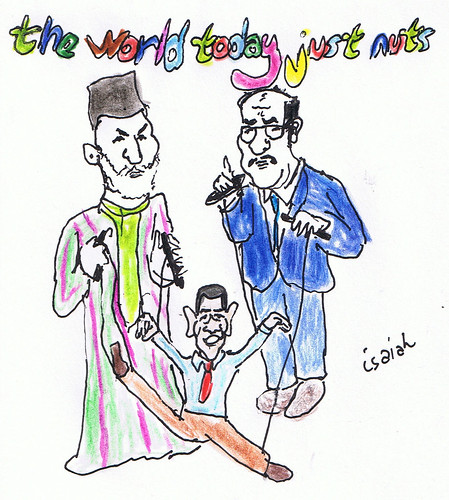
Isaiah's The World Today Just Nuts "These days, puppets pull the strings" from yesterday.


These days puppets pull the strings


I really think Isaiah does a great job of capturing Nouri anytime he draws him. He nailed Karzai as well.

Turning to Hillary is 44's "Temple Prostitutes:"

For those not well versed on Temple Prostitutes in the Biblical era there are many sources of information from which to learn. Temple Prostitutes were both male and female and they were certainly abundant. The books of Deuteronomy (23:17 – “None of the daughters of Israel may become temple prostitutes neither may anyone of the sons of Israel become a temple prostitute.”), Kings I (14:23, 24 “And they too kept building for themselves high places and sacred pillars and sacred poles upon every high hill and under every luxuriant tree. (24) And even the male temple prostitutes proved to be in the land they acted according to all the detestable things of the nations whom Jehovah had driven out from before the sons of Israel.” 15:12 “According he had the male temple prostitutes pass out of the land and removed all the dungy idols that his forefathers had made.” 22:46 “And the rest of the male temple prostitutes that had been left oven in the days of Asa his father he cleared out from the land.”), and Leviticus (19:29 “Do not profane your daughters by making her a prostitute in order that the land may not commit prostitution and the land actually be filled with loose morals.”) are replete with anecdotes. As much as we would enjoy a thorough discussion of Biblical era Temple Prostitution, the practices and variations, and meanings, we won’t engage. We have modern day Temple Prostitutes to worry about.

That's from Sunday. Hillary is 44 didn't post today. Maybe they had a busy day?

I did. I meant to mail back some DVDs to Netflix so I'd have some by Wednesday. I woke up late and had no clean socks. Meant I not only had to hurry because I was late, I had to run to the drug store to get some clean socks. (How did I end up with no clean socks? I forgot to do laundry.)

So there was no time to gather up the DVDs and the envelopes to send them in.

Then I went to my drug store and found out that my favorite clerk there (he's actually one of the managers there) is quitting because they've reduced hours and he can't afford to drive an hour (he lives a bit away) each day for that pay. This is a huge chain store and he should be able to transfer to any of 3 that are closer to him but they won't let him transfer so he's quitting.

Meanwhile an old friend from high school just learned that they're doubling furlough days at his job. (That's a day off without pay.)

And Barack's pitching baseballs (as if they're softballs)?

Going out with C.I.'s "Iraq snapshot:"


Monday, April 5, 2010. Chaos and violence continue, Baghdad is slammed with bombings on Sunday, WikiLeaks releases classified video of a US attack in Iraq, Lie Face Melissa Harris-Lacewell gets some attention (not the kind she likes), as does another political whore and more.

Starting with elections, on
the latest Inside Iraq (which Al Jazeera began airing Friday), Jasim al-Azawi spoke with the Ministry of National Dialogue's Saad al-Mutallibi and King's College's Mundher al-Adhami.

Jasim al-Azawi: Saad al-Mutallibi, back in the 2005 election the ruling was that the biggest winner of the election would be called upon to form the government. Now the rulings have changed, the game has changed and, instead, the biggest bloc in Parliament will be called upon to form the government. Isn't that a manipulation?

Saad al-Mutallibi: Uh, I don't know. I wouldn't call it a manipulation. I call it a necessity of circumstances. In 2005, there was a clear majority to one political bloc, 132 to one political bloc. That naturally, that inherited the formation of the government which looked normal in the circumstances. Today we don't have such a clear cut. Nobody achieved majority. Everybody achieved minority, really. Unfortunately, we do not have a Constitutional Court. That was another failing of the last Parliament. They could not reach an agreement on forming the Constitutional Court so we have to rely on the federal court. The federal court ruled that if a group, by election, forms a majority then that group will be called upon to form the government. If no such group exists, then a coalition of political parties should form together to reach the 163 margin, then they will be able to form the government.

Jasim al-Azawi: Perhaps we should clarify, Mundher al-Adhami, that federal court is a left over from the previous government and this Constitutional Court Saad al-Mutallibi referred to has never been established, was never formed, although Articl 92 in the Constitution calls upon the formation of a Constitutional Court in order to have the jurisidiction over Constitutional problems like the election. The federal court is simply a one-man person. This is Madhat Al Mahmood and his ruling is not even binding so why is is that the government as well as all of the political rivals are taking heat from him?

Mundher al-Adhami: You know, Jasim, I am sickened by the whole process in Iraq. That's from the beginning of the occupation. These elites -- the new elites, the new political class created by the American invasion has been playing these games from the beginning. And while Iraqis are dying or they are [. . .] by an education, they are deprived of basic services. These politicians are after the one thing for themselves and they're not -- they can't even agree among themselves to share the spoils of this destruction of the country between themselves. It is a sickening process. This so-called court has been changing their mind every now and then according to the pressures applied by this quarter or the others.

Jasim al-Azawi: Since you mentioned changing of minds and subcoming to pressures and Saad al-Mutallibi is in the camp of the State of Law bloc headed by the prime minister, Saad al-Mutallibi, how conveinent for the prime minister when he was edging and he was leading in the poll he said, "The biggest winner should be called on to form the government." Now that he is lagging behind not only he is using scare tactics, the policy of fear, that unless there is a recount the country will deginerate into civil war. What kind of scare tactics is this?

Saad al-Mutallibi: Well, it's not exactly like this. What happened is that three months ago Madhat Al Mahmood ruled that the biggest bloc in the Parliament should form the government and Mr. Maliki was upset with that ruling because naturally he thought he would form a majority or gain a majority of the Parliament. But he didn't do anything about it. He just leaves it to express his feelings that he wasn't happy about it. Now the ruling has turned to his advantage, he has expressed his feelings again. And there wasn't any idea that people would right in the streets and going to start violence. Far, far from that. Actually the political, the security environment is not bad at all in Baghdad. It's quite comfortable. People are moving about daily life.

We'll stop there. The problem with waves of Operation Happy Talk is you're not always able to ride one to the shore. Reality often has a way of slamming into you before you make it that far. Such is the case with al-Mutallabi's ridiculous claims that Baghdad's "security environment is not bad at all". Yesterday, Baghdad was slammed with bombings. Focusing only on the three aimed at foreign embassies, at least 41 people were killed and over 200 were left injured.
Laith Hammoudi's McClatchy Newspapers observed, "The blasts will color the intense political negotiations that are under way after the March 7 parliamentary election, raising questions about which candidates have the security credentials and the ability to cut across sectarian lines to lead a still-unstable Iraq". Alice Fordham (Times of London) quoted survivor Ali Sanz Ali stating, "I heard the sound of the explosion and ran out into the street to see a big cloud of dust and smoke. On the other side of the street, many cars had been destroyed and burnt. You could see the dead." Fordham also notes that the Iranian and Egyptian embassies were clearly targeted but the other bombing may have been meant for the Syrian Embassy, the Spanish Embassy or the German Embassy. Or it might have been a way to strike all three ("the third struck an intersection near the Germany, Spanish and Syrian missions"). Jamal Hashim (Xinhua) notes that they were suicide bombers who "detonated car bombs wihtin minutes of each other" at the three embassies with the Iranian Embassy being the third one attacked. Cab driver Abu Ahmed tells Prashant Rao (Australia's The Age), "The explosion was really strong. They never kill ministers, officials or heads of state. They kill tax drivers, public employees and shopkeepers. How much longer will this last?" Adam Schreck (Daily Record) adds, "TV news footage showed civilians loading casualties into police vehicles and ambulances as bloodied survivors tried to flee." Jim Muir (BBC News) explains of the near bi-montly Baghdad bombings targeting government buildings since August of 2009, "Each of the multiple bombings which have hit Baghdad over the past year has been 'themed' - clearly with the aim of conveying the message not only that the insurgents can strike several targets simultaneously, but that they can focus on a particular type of target each time." Martin Chulov (Guardian) gets reactions from Iraqi men and women such as Abeer Ahmed who states, "Security won't be sorted out here any time soon. Look at the situation. All our leaders are busy fighting with each other for good positions for themselves and leaving the country to drown in blood. My child refuses to go to school and how can I blame her. There are many parties to blame for this carnage, firstly the current government, which can't stop it, and secondly the regional countries who are not happy with democracy in Iraq." Al Jazeera's Zeina Khodr reports (video link embedded in page) in the aftermath and shows much of the damage from the bombings.


That was Sunday. Saturday brought news of an early morning attack.
Mohammed Al Dulaimy (McClatchy Newspapers) reported, "Gunmen dressed in Iraqi army uniforms stormed three houses overnight Saturday in a Sunni Muslim village south of Baghdad and killed 24 people, including five women, Iraqi authorities said. Most of the slain villagers belonged to 'Awakening' groups, the bands of U.S.-backed Sunni fighters who helped in the fight against al Qaida in Iraq. The attack occurred in Al Bu Saifi village south of Baghdad." Muhammed al-Obaidi and Timothy Williams (New York Times) added that the nineteen males were predominately Sahwa members and quote Luyai Khadum stating of his four brothers and father, "They were all killed. I lost five family members. We are a Dulaimi family, so why would they do this to us." David Batty (Guardian) revealed, "The victims were bound with handcuffs and sprayed with machine-gun fire. Some of the bodies were 'beyond recognition', according to a senior Iraqi army official who wished to remain anonymous." BBC News quoted Muhammad Mubarak stating, "A group wearing National Guard uniforms and carrying night vision equipment stormed the homes of the victims and took them to their front gardens. Then they handcuffed them with plastic tape and shot them in the head with guns fitted with silencers." Leila Fadel and Aziz Alwan (Washington Post) reported the assailants arrived with a list, gathered all the possible Sahwa members, "looked through a list of names and then used guns with silencers attached, shooting people one at a time" and that the murders "were reminiscent of those carried out against Sunni Arabs by Shiite death squads from Iraq's interior ministry." Sara Hashash (Times of London) observes, "The massacre intensified fears of renewed violence as Iraq's two main political coalitions (led by Iyad Allawi, the former prime minister, and Nuri Al-Maliki, the incumbent prime minister) battle to form a government following elections that left neither with enough seats to rule alone." Meanwhile Al Jazeera's Zeina Khodr wonders if this "could be the Iraqi style of negotiating." Today violence continued and Saad Abdul-Kadir and Elizabeth A. Kennedy (AP) reports that a family was shot dead outside their Baghdad home -- both parents and four children ages six to eleven. Two daughters, who were upstairs when the assailants came to the the home, survived. Reuters notes a Basra roadside bombing claimed the life of 1 police officer and left three more injured and, dropping back to yesterday, that 1 man was shot dead outside his Mosul home.

Violence is in the news today as
WikiLeaks has released "classified US military video" from 2007 "depicting the indiscriminate slaying of over a dozen people in the Iraqi suburb of New Baghdad -- including two Reuters news staff" Nami Noor-Eldeen and Saeed Chmagh. Reuters has repeatedly been denied the video despite multiple FOIA requests. Al Jazeera interviews Julian Assange about the leaked video.

Imran Garda: Now a video has been released on the internet purporting to show US military personnel firing at civilians in a Baghdad square in 2007. Two journalists -- one journalist, Reuters journalist and his driver were killed in that attack. This video has just been released by the online whistler blower WikiLeaks. We can now speak to a member of WikiLeaks. Joining us from Washington is the editor of WikiLeaks.org Julian Assange. Thank you very much for joining us. So, first of all, take us through what exactly, in a nutshell, this video shows.

Julian Assange: This is a video of an Apache helicopter on the 12th of July, 2007 in the Iraqi suburb of New Baghdad. It shows a number of things. It shows an attack on a group of people. Two of which are Reuters journalists from Baghdad. Those men are killed by 30 milimeter cannon fire. There seems to be some initial confusion as to whether those people are carrying weapons and that the Reuters' photographer's camera was a weapon. But it proceeds from what might have been an excuse for not concentrating too much, to something far more serious. When one of the Reuters photographers is crawling away, wounded, clearly he doesn't have a weapon, clearly of no threat and a van tries to rescue him which passes by and two children inside. That van is then attacked and the Reuters staff member, Saeed, is killed along with all the people in that van except for the two children who survived but were seriously wounded.

Imran Garda: Yes, I was --

Julian Assange: After that -- I'm sorry, go on.

Imran Garda: No, no. Please continue. Please continue.

Julian Assange: Just 20 minutes after that serious and disturbing event, a Hellfire missile attack is conducted on a nearby house. That from -- The roof appears to be under construction. And that attacks kills another -- by the military record -- six people. But maybe potentially more, anotehr six. The military say that insurgents went in that hour or lived in the house or went into the building. But our people have shown that in fact there were three families in that house and we have the records of some of their deaths -- including two women. And so on. It is possible that some armed men walked into that house but the majority of the people in that house seemed -- at least the majority of the people that lived there seemed to be regular families and we have evidence from the person who owned the house and photographic evidence of the Hellfire missile and so on.

Imran Garda: How sure can we be of the authenticy of this video? Not only the picture itself but also the voice over -- the voices we hear which I'm assuming are the pilots in the cockpit of the helicopter.

Julian Assange: Yes, yes.
Imran Garda: Because those are quite revealing in many ways.

Julian Assange: Yes.

Imran Garda: How sure can we be that this is the real deal?

Julian Assange: As sure as one can be of anything in life. The material is internally totally consistent but also there was a Washington Post reporter [David Finkel] who was with that unit, the US military unit, on the ground, on the day. And he wrote a chapter in a book which was published last year, a book called The Good Soldiers which correlates directly to the material in that video, including to the radio transcript for the first half.

Imran Garda: Right.

Julian Assange: That's a strong correlation. Also Reuters conducted a number of investigations, interviewed two ground witnesses at the time.

Imran Garda: Right.

Julian Assange: That report really wasn't taken seriously by [. . .] 'It's just another few reporters dying in Baghdad.' And nothing to back up the witnesses. But now we have the video that shows the witnesses were correct. Also there was an Iraqi police report that Reuters says agrees with with their witnesses and all of them agree with the video.

Imran Garda: Sorry to interrupt you. Not long afterwards, Lt Col Scott Blackwell from the US military told the New York Times that, "There's no question that coalition forces were clearly engaged in combat operations against a hostile force." You even mention that quote on your website and on the video itself. And, of course, when Reuters requested the video from the Pentagon under the Freedom of Information Act, they didn't get it. With all of that in mind, do you firmly believe that there was a cover up at play here?

Julian Assange: They were certainly spinning the message and it does seem like there has been a cover up. The Rules of Engagement that were used for that circumstances, if the internal assessment was -- those rules were correctly applied -- and that is the statement the US military applied, that is the statement the US military made to Reuters, then those rules are a serious, serious problem if they permit such events. But-but there were clear lies made at the time and shortly after about the military not knowing, for example, not knowing how the children were injured and trying to suggest they didn't know how the jounalists were killed. And very early on they listed all the people killed -- other than the children -- as insurgents.

Imran Garda: Julian Assange, pleasure hearing your thoughts. Thank you fvery much for agreenin to talk to us here on Al Jazeera

Martin Fricker (Daily Mirror) reports the US military has confirmed that the video is "authentic." Chris McGreal (Guardian) describes the video:

One of the helicopter crew is then heard saying that one of the group is shooting. But the video shows there is no shooting or even pointing of weapons. The men are standing around, apparently unperturbed.
The lead helicopter, using the moniker Crazyhorse, opens fire. "Hahaha. I hit 'em," shouts one of the American crew. Another responds a little later: "Oh yeah, look at those dead bastards."
One of the men on the ground, believed to be Chmagh, is seen wounded and trying to crawl to safety. One of the helicopter crew is heard wishing for the man to reach for a gun, even though there is none visible nearby, so he has the pretext for opening fire: "All you gotta do is pick up a weapon." A van draws up next to the wounded man and Iraqis climb out. They are unarmed and start to carry the victim to the vehicle in what would appear to be an attempt to get him to hospital. One of the helicopters opens fire with armour-piercing shells. "Look at that. Right through the windshield," says one of the crew. Another responds with a laugh.


In peace news, Afghanistan War veteran and Iraq War resister Matthis Chiroux has a new essay entitled "
Beyond Flagatory" (World Can't Wait):Since my burning of the American Flag in protest of the war and the U.S. Empire, I have been called both a sinner and a saint. Members of my movement, people who I love, have published letters and comments both in support and opposition of what I see as a righteous and timely stance. Individuals have gone so far as to assert that my non-violent act of resistance to war and empire was indeed an act of war itself. I lament what I see as such a misconstrued analogy, and hope that in time people will see the folly of their condemnations. The struggle to end war and the struggle to end U.S. Empire is one. As long as the latter exists, the former will be an inevitability as has been demonstrated since our founding. For too long as a movement, we have divided ourselves and diminished our message, for the sake of public image, at the cost of enough blood to stain every flag in history. This cycle of violence will continue unbroken until a few are willing to stand against the many wielding little more than truth and a determined will to be free. I count myself among the few, but have faith that soon, we'll be the many. One U.S. flag and my reputation as a leader is a small price to pay for a message of purity that may bring an empire at last to its knees. I am no Martin Luther King, and shall not claim greatness before any person, but I will embody those examples left to us by greatness past, and will hold true to the cause of speaking truth to power, even if that power is embodied in my peers.We will know peace within our lifetimes, but first, we must know truth. Truth is not a process of negotiation; it is not a compromise and it is not consensus. Truth comes from within, and with it the power to create new worlds and lay those of old to rest. It also comes with great personal sacrifice on behalf of those who carry its weight.Matthis' actions were Constitutional and are not appalling. Appalling is not making a statement. Appalling is silence. Shameful is silence when you know you should speak out. Matthis made a big statement. Maybe if others would carry their weight he wouldn't have to carry all the burden? Matthis' speech and actions are not the problem, the problem is the silence. Cindy Sheehan did an amazing job responding to the nonsense attacks on Matthis and Elaine Brower. Matthis earlier wrote about his DC rally actions here.

Refugees will wait until tomorrow. Sorry. Ava and I have been charting Lie Face since January 2008. So when Melissa Harris-Lacewell is being 'reviewed,' we'll make room for it. First up,
Chris Floyd (Empire Burlesque):

Charles Davis (via
Jon Schwarz) has an incisive take on the high fluttery flail induced in our imperial courtiers by the latest Tea Party tantrums. Davis demolishes a piece in The Nation by progressive paladin Maria Harris-Lacewell, in which she waxes lyrical -- not to nonsensical -- about the great threat to "the legitimacy of the state" posed by Tea Partiers disrespecting our elected officials. These acts -- spitting, swearing, insulting, shouting, etc. -- which might have been considered legitimate expressions of citizen anger (or at least good clean fun) if directed at, say, George Dubya or Dick Nixon, are now to be regarded as -- I kid you not -- "an act of sedition" when aimed at the ruling party.

Melissa Harris-Lacewell, whom
Ava and I were just laughing about in our V review yesterday, earned the name "Lie Face" when she went on Democracy Now! in January 2008 (the first time) as an independent observer commenting on the Democratic Party's candidates for their presidential nomination. Though Melissa had begun working on Barack's campaign in the summer of 2007 -- and had bragged about that to Bill Moyers in real time -- and though Amy Goodman knew that Melissa worked for Barack's campaign and had discussed that with Melissa on Rev. Jesse Jackson's radio show before Melissa ever made her first appeareance on Democracy Now!, neither whore felt the need to tell you that Melissa -- raving wildly over Barack -- was not the independent analyist she was presented as but part of the Obama campaign. (Her second January 2008 appearence on Democracy Now! would find Melissa shouting at Gloria Steinem about how she was campaigning for Barack while "sitting here in my blackwoman hood body" -- yes, she often sounds as if she's on drugs.) Melissa, as Ava and I again noted in March 2008, would repeat her trick on The Charlie Rose Show -- somehow invited onto a journalist panel, Melissa would never mention that (a) she wasn't a journalist or that (b) she was part of the Obama campaign. She would make time to savage Tavis Smiley. She would make time, LIE FACE, to say people were outraged about Tavis. She'd forget to inform Charlie and the viewers that "people" were Melissa Harris-Lacewell and her online sock puppets (she used a lot of her college students promising them extra credit) and that Melissa was the one who wrote "Who Died And Made Tavis King?" She simply 'forgot' all that. Whore like that and The Nation figures you're perfect for their brothel.

Now for
Charles Davis (false dichotomy):

Maria Harris-Lacewell is a professor at Princeton University, as so subtly alluded to in the above excerpt from her latest drivel for The Nation, and she's concerned about the "legitimacy" of the state -- a legitimacy she assumes but doesn't explain -- which she notes some backwards reactionaries have had the temerity to challenge in the age of Democratic government. Now, considering that U.S. government imprisons more of its own citizens than any other in the history, with 25 percent of the world's prisoners; that it has more military bases in more countries than any previous empire in history, and has killed millions of people from Iraq to Vietnam; and that its current head, Barack Obama, is openly targeting for extrajudicial killing Americans and foreigners alike, one might ask: why is a liberal magazine so concerned about this state's legitimacy? Because of the Tea Party movement, you see, whose flashes of racism and disrespect toward politicians is of more concern to Ivy League academics than the "legitimate" state violence they applaud. Tea Partiers, by accusing the current administration of "various forms of totalitarianism . . . are arguing that this government has no right to levy taxes or make policy," the professor writes, apparently under the mistaken belief that most taxes the state levies go to gumdrop bridges and fairy dust health clinics, rather than less wholesome things like aircraft carriers and daisy cutters. Rather than focusing on what the state actually does, though, Harris-Lacewell, like most liberals, would prefer we focus on their shining, abstract ideal of what it could be, while sanctimoniously dismissing those who see no distinction between state-sponsored and private sector murder, an approach befitting the wait-until-you're-called merit-class liberal mentality that dominates the Democratic Party and the progressive press. As The Nation's house political scientist explains it, adopting an argument that one could never imagine being applied to the left, "When protesters spit on and scream at duly elected representatives of the United States government it is more than act of racism. It is an act of sedition." Put another way: offenses against the state are inherently more despicable than any offense one could commit against some poor schmuck civilian. An overstatement? Well, no, as Harris-Lacewell herself demonstrates in writing about Congressman John Lewis (D-GA), who "is no longer just a brave American fighting for the soul of his country- he is an elected official. He is an embodiment of the state." Yeah, you know, before Lewis just marched in the streets against racism and state-enforced segregation as a (ho-hum) private citizen, but now he chairs a subcommittee -- show him some respect!

Poor Lie Face Harris-Lacewell. The old whore gets a little attention but the fellows can't remember her first name and call her "Maria." Poor Lie Face.

Dealing with another liar -- Rachel Maddow who refused to call for an end to the Iraq War and, in fact, spent years on Air America Radio insisting that the US had to remain in Iraq, now whores it up on MSNBC where, as
Bob Somerby has repeatedly noted, she fixes quotes and breaks facts in order to offer 'insight' Rachel, AAR is no more so let's be honest. Every one at AAR management? They knew that was your father writing all those e-mails requesting that you be given your own show. They laughed at you, Rachel. They laughed at you because you weren't just a whore, you were a dumb whore. Having refused to walk out as Lizz did, having refused to stay away as Chuck did, you had demonstrated that you were the biggest corporate whore and having your father write all those lame e-mails only made you appear even more pathetic in management's eyes. Today Justin Rainmondo (Antiwar.com) takes on the Scott Baio look-alike's worship of authoritarianism:

How quickly these lefties forget. Intoxicated by power and by the prospect of smashing their political enemies using the mailed fist of the State, modern "liberals" of the Maddowist persuasion either don't know or don't want to be reminded of how J. Edgar Hoover's FBI was used as a political weapon of mass destruction by the Nixon administration to crush political dissidents of the left during the 1960s and 70s. White leftists and black nationalists were infiltrated, disrupted, set up, and jailed – the government used agents provocateurs to initiate violence, and then moved to repress these movements, jailing the leaders, and using massive force against antiwar demonstrators: remember Kent State?
The FBI's massive campaign of disruption was known as "
COINTELPRO," and the revelations of how extensive were the government's efforts to infiltrate leftist and black groups are generally considered shocking in retrospect. For example, at the height of the antiwar movement, at least a third of the members of the Socialist Workers Party (SWP), at the time the main Trotskyist group in the US -- and a key organizer of the mass protests -- were police agents, either FBI or paid informants. These agents actively encouraged violence, planted "evidence," and set up radicals for government repression. The same tactics, and worse, were used against the Black Panther Party, which, in a gesture unconsciously mimicked by today's right-wing populists, once showed up on the steps of a Sacramento courthouse armed with shotguns and posed for the cameras.
Paid informants spying on the legal activities of American citizens, agent provocateurs, and outright dirty tricks (such as disseminating printed materials meant to cause division and provoke violence) -- it was an altogether shameful chapter in the history of American law enforcement, one that nearly everyone but the most unrepentant neocons agree shouldn't be repeated -- and yet here is Ms. Maddow, an alleged "liberal," celebrating its rebirth.


iraq
al jazeera
inside iraq
jasim al-azzawi
mcclatchy newspaperslaith hammoudithe times of londonalice fordhamxinhuaxu yanyanjamal hashim
bbc newsjim muir
the daily recordadam schreck
mohammed al dulaimithe new york timesmuhammed al-obaiditimothy williamsthe guardiandavid battybbc newsthe washington postleila fadelaziz alwanthe times of londonsara hashashal jazeerazeina khodr
the guardianmartin chulov
chris floyd
the world cant waitmatthis chirouxcindy sheehan

Friday, April 2, 2010

Deanna Durbin

Who is Deanna Durbin?

I didn't really know. She's actually responsible for a lot of things. She was a child actor at MGM and she and Judy Garland made a short together which showcased Durbin's operetta style singing against Judy's jazz style. (They give a free concert in the park. You can see it on the videotape release of Summer Stock with Judy Garland and Gene Kelly.)

Deanne Durbin quickly moved over to Universal where she starred in a series of pictures and became a top money maker.

So that's one reason to know her.

Another reason?

If MGM hadn't let Deanna go and realized after that they made a mistake, we might not have the Judy Garland we all love.

Why's that?

Shirely Temple was considered for the role of Dorothy in The Wizard Of Oz but Mayer of Metro Goldwyn Mayer (MGM) felt that MGM shouldn't be in the business of making a big budget film to promote a 20th Century Fox star (Temple). And he'd let Durbin go, so Mayer really wanted Judy to be a star.

And she was.

So I found out all of that and then asked C.I., what Durbin movie to see? I'd only seen the short with Garland.

C.I. asked me a few questions and then suggested Lady on a Train.

I love that movie.

First the singing. She impersonates a night club singer so she sings at that point in the movie. But the whole thing takes place around the Christmas holidays. And she's left San Francisco to spend the holiday with her aunt and uncle. At one point, she calls her father to wish him a Merry Christmas and he asks her to sing "Silent Night." That's probably her best moment in the film in terms of the way she looks and the way she moves you.

Lady on a Train?

She arrives by train. As she does, while reading her mystery book, she sees a murder take place out the train window. She goes to report it to the police -- who happens to be Fred Mertz, so pay attention for William Frawley -- and they're no help so she decides to solve it herself. It's got a nice blend of everything including comedy. It's just a really funny and charming movie. It's got everything, even a happy ending.

Going out with C.I.'s "Iraq snapshot:"

Friday, April 2, 2010. Chaos and violence continue, 'election madness' continues in Iraq, The World speaks with soldiers on yet another tour in Iraq, KBR faces a new lawsuit, and more.
Starting with life in free and wonderful Iraq. Wamith Al-Kassab shares at CounterCurrents:

In the summer of 2008, I survived an assassination attempt in Iraq. My "crime" was that I am "an enemy of God," a promoter of concepts that "offended" religion. My crime was writing articles calling for the protection of religious minorities and calling for the rights of women, children, and homosexuals in Iraq, urging people to protect innocent people from brutal attacks by armed militias.

My principles forced me to live in harsh humanitarian conditions as I search for a safe haven, and as many of the countries which adopted human rights protection, bloggers from Iraq are not in the ranks of immediate threat, and I am thus forced to stay in search for protection.

We pay a high price in order to convey the reality of death and destruction in Iraq and to defend freedom of expression. While I live the reality of my search for a lifeline away from a death sentence awaiting me in my home country, I receive no means of protection and every day I come closer to face death again because of the programs forcing Iraqis to return, adopted by several European countries through treaties the Iraqi government put fourth.

Somehow the reality never matches up to the word from the White House -- regardless of which party occupies the White House -- does it?
Today on the second hour of The Diane Rehm Show (NPR), Diane and her guests -- joined by Tom Gjelten (NPR), Moises Naim (Foreign Policy) and Mary Beth Sheridan (Washington Post) -- addressed Iraq.

Diane Rehm: Let's turn now to Iraq and the elections there. Are we any closer to knowing who is going to be the next prime minister, Mary Beth?
Mary Beth Sheridan: You know, I think that we are probably weeks away. And, you know, I think what's really important about this issue -- it's so easy over here I think for your listeners to find the whole thing rather baffling all these parties that are jockeying and so on and one guy won but will he form a coalition? You know, I guess for me -- I've spent some time in Iraq -- the main question is: Can they work this out peacefully? Because Iraq has a history of resolving its political disputes by force and, of course, President Obama wants to end combat operations in August and you're looking at weeks, months of jockeying to form a government so I think there's a real question here about -- and real implications for -- US strategy.
Diane Rehm: And what role is Iran trying to play in this election?
Mary Beth Sheridan: Well that's a very interesting point. A lot of the leaders of the Shi'ite parties have gone to Iran to consult. They are very influential. They have some control over militia groups. There's money that flows in. So they're definitely a big player in this -- uh -- in this political issue.
Diane Rehm: And there's going to be a vetting panel, Tom?
Tom Gjelten: Well, the problem is that the alliance that won, Mr. Ayad Allawi, a secular, sort of largely Sunni group, uhm, is uh just two seats ahead of the alliance led by Nouri al-Maliki, the current prime minister. Well the government is in the hands of Maliki and therefore --
Diane Rehm: And he says it's fraud.
Tom Gjelten: -- he has a real interest in disqualifying some of these candidates because that would then put him ahead and with just a two seat margin, there's not a lot of leeaway here, in fact, it's interesting, some of the -- some of the -- some of the candidates -- some of the Parliementary candidates in Mr. Allawi's group have basically gone underground to stay out of reach of the law because the government is trying to come after them.
Diane Rehm: Ah-hah. So Mary Beth's concerns are valid. Go ahead, Moses.
Moises Naim: And both Mary Beth and Joe -- Tom, are right, this is not any election. Because you could say, "Well this is democracy at work, you know. It happens all the time that you have to build coalitions and do some horse trading and create a government and so on." But here we are in a different game because, as Mary Beth says, if this ends up with violence or if there is huge fraud then the exit of American troops will also be more difficult.
Diane Rehm has been awarded a Peabody for her work this year (here for the list of winners) and they note of her show, "Now available to National Public Radio listeners after decades on Washington's WAMU-FM, Rehm's talk show is the gold standard for civil, civic discourse." Congratulations to Diane and her team. Earlier this year The Diane Rehm Show won a Shorty Award for their real-time Twitter platform, so she leads the year with traditional media (Peabody Award) and new media (Shorty Award).
Back to the elections, the Washington Post's Leila Fadel (via Sydney Morning Herald) explains, "In a sign of hardening sectarian divisions, the secular, largely Sunni-backed bloc that won the most seats in Iraq's recent parliamentary elections says its victorious candidates are being subjected to a campaign of detention and intimidation by the government of the Shiite Prime Minister, Nouri al-Maliki." For background on the attempts to target/smear successfully elected candidates as "Ba'athists," CNN notes:

A controversial committee that nearly derailed the Iraqi election in January has resurfaced. Led by Ahmed Chalabi, a former ally of the Pentagon, the committee this week announced that six winning candidates in the March 7 parliamentary election are connected to the former regime of Saddam Hussein and must be disqualified.
Critics say it's no coincidence -- disqualifying them will erase the lead of secular candidate Ayad Allawi and his Iraqiya alliance of Shiites and Sunnis. Allawi's electoral list won 91 seats in parliament and topped the State Of Law coalition of Prime Minister Nuri al-Maliki, which won 89 seats.
Tom Gjelten's point about people going into hiding was reported on by Ned Parker (Los Angeles Times) who reported in today's paper on Sheik Qais Jabouri, a memer of Allawi's slate elected to the Parliament, who went into hiding yesterday after Nouri's security forces ransacked his home looking for him and this has led to allegations (I'd say truthful statements) "that Prime Minister Nouri Maliki is carrying out politically motivated arrests to stay in power after his own Shiite Muslim-led slate finished a close second in national elections March 7."
This attack was a continue to the attack launched by officials from the Justice and Accountability Committee Started before the elections under assuming of preventing candidates connected to Saddam Hussein's ruling Baath party from standing for elected office. As they prevented About 500 candidates were from standing before the election by the commission Another attacks were in changing the constitution translation for paragraphs that say that the top vote-getter should have the first shot at forming a government. to those who got bigger collation from sets holders as the Supreme Court concluded, at Maliki's urging, that the right to form the next government could go to alliances and super-coalitions formed after the election, if they prove to have the most seats. Maliki promptly launched negotiations with other religious Shiite and Kurdish parties. They current leaders of the government concentrate of staying in power than focusing instead on building peace and stability in Iraq. Many of the votes for Allawi were votes for a strong national government in Baghdad and against sectarianism.
As Nouri and his cronies attempt to overturn the will of the people, Moqtada al-Sadr comes off looking like he's committed to giving the people a voice (and he may well be). Xinhua reports that voting has begun to determine whom the Sadr bloc (which won 40 seats in the election) should back for prime minister. Voting takes place today and continues tomorrow. Khalid al-Ansary (Reuters) quotes a statement from Moqtada al-Sadr which was "read to his followers before Friday prayers" in which he states, "According to political developments, a mistake might occur in choosing the next prime minister, and for that I think it is in the (national) interest to assign it directly to the people." Leila Fadel and Aziz Alwan (Washington Post) report on the developments and offer an in-depth walk through on the past tensions between al-Sadr and Nouri al-Maliki stemming from Nouri's attack on followers of Moqtada al-Sadr in Basra and Baghdad. They noted, "Sadrists may use the informal referendum, which continues Saturday, as an excuse not to bak Maliki who already endured a blow earlier this week when another Shi'ite party appeared to back former primer minister Ayad Allawi's Iraqiya bloc." That move that may halt Nouri's attempt to nullify the voice of the people, Nayla Razzouk (Bloomberg News) reports, came via Ammar al-Hakim, head of the Iraqi National Alliance (which al-Sadr's bloc is a part of), who posted online, "We will not participate in a government that does not include Iraqiya." Zaid Thaker and Timothy Williams (New York Times) inform that the voting today and tomorrow is open to all and they describe a scene of voting, "A crowd of about 100 would-be voters excitedly mobbed tables where the official green paper ballots were being distributed. Some people took several ballots and handed them to friends and relatives in the throng behind them. As pushing and shoving intensified, people began to shout at one another."
"The war in Iraq is not over and we as a nation will be dealing with its aftermath for a long time," noted The World (PRI) today in the intro to Ben Gilbert's report on some of those serving in Iraq (US Army's 3rd Infantry Division's 1-64 amor):.
David Shumate: My name is David Shumate. I'm from Palm Bay, Florida and I'm 27-years-old. And I'm from Alpha Company 1-64 Amor. This is my fourth tour in Iraq. I've been in the invasion OIF3, OIF5 and OIF8. I was active army right after September 11th and then deployed to Kuwait and then a few months after a lot of training, we invaded Iraq. So, yeah, we lost two guys and had eighteen wounded. But I mean, really, once we got into Baghdad, basically it was kind of over. It was just once we got there, we did -- It all stopped basically and it was kind of amazing. When I was on my first combat -- my first patrols into Baghdad, it was amazing. I was actually getting flowers from people, bouquets of flowers from women and they were happy and cheering that we were there. So a lot has changed from the first few weeks of Baghdad. It's a couple of weeks after that when the insurgency really started its effect on the people.
Mike Bailey: My name is Mike Bailey. I'm from Belle Chasse, Louisiana and I'm 27-years-old. This is my fourth time to Iraq. The first time I was here, with 1st Marine Division, was down in Babel Province. The second round, I switched over and came as part of 1st Marine Regiment in Feburary 2004. We went to just outside Falluja in Anbar Province and the word of the day was IEDs, they were everywhere I mean people were more worried about what was going on the side of the road than what was going on on the roads and that one definitely started off with a bang with the four Blackwater conrtactors that got killed two or three weeks after we got there. Not too long after the Blackwater contractors were killed we moved into the city of Falluja with several battalions and started, basically, rooting out the guys that were coming out to fight us. And there was a lot of them, a whole lot of them. It seemed like everybody had an RPG or a gun in Falluja back then. You couldn't get very far into the city before you started hearing booms and richochets coming off vehicles and stuff like that. They definitely wanted to fight us head on.
James Ausmann: My name is Staff Sgt James Ausmann. I live at Fort Stewart, with my wife and kids, so that's home. I was with the 1st Batallion, 18th Infantry, first ID. We were based out of Tikrit, just south of here. Saw the end of all the major combat and the beginning of all the IEDs. There was no armor on our vehicles, so that made it for interesting times
Ben Gilbert: This was back before armored humvees, right?
James Ausmann: (Laughs) Yeah, yeah. So we had all the soft skin humvees with all of the Secretary of Defense trying to get us the armor in a rush. And you know, to their credit, nobody knew what the IED threat was until we hit it. So.
Ben Gilbert: Yeah, right. Did you -- did you guys hillbillly armor your vehicles?
James Ausmann: Oh yeah. Plywood, sheet metal, sandbags, everything you could of think of, we put on there. Some of it worked.
David Shumate: David Shumate. I was twenty when we invaded and now I'm fixing to turn, about to turn 28 so a big chunk of the 20s. Wow, it's from OIF3 to today, it's night and day. The Iraqi army is a lot more established. We no longer, really, can go into the cities without Iraqi escorts. We can't go into an Iraqi house without an Iraqi escort and without a warrant or permission. So, um, it's night and day. So basically OIF3 was if we felt something was suspicious or something was going bad in that house, we went into that house and took care of business and so now basically the Iraqis have control of everything and we're just there to support them.
Mike Bailey: Mike Bailey. You get the feeling that it's the last deployment. Basically told that you guys are going to turn the lights off on the way out the door.
Ben Gilbert: How much time have you spent in Iraq?
Mike Bailey: Let's see here. Three years of my twenties have been spent in Iraq. Parts of me are sick of coming here, being away from a toddler -- my daughter was just born, I actually missed her birth the last time I was here -- and being away from my wife of eight years. But this is what I signed up for when I was 18-years-old and this is what I know, and my wife came into and we know it's one of those things that's going to happen we're prepared for it.
James Ausmann: I'm one of those guys, I want to see it all the way through. I'd rather stay here another year or two and get it done right then leave to early. I want us to leave and for this to work out, not for us to leave and the country have issues.
Turning to KBR -- and isn't it a rare week when we don't -- often several times -- February 25th a federal judge dimissed a case against KBR -- not ruling on the merits of the case, just addressing the issue of jurisdiction. Jeffrey Rainzer (Doyle Rainzer LLP) explained, "Today, the federal court dismissed the claims of the Indiana National Guardsmen in 'McManaway et al v. KBR, Inc.' pending in Evansville, Indiana. The Court found that the KBR defendants could not be sued in Indiana. We are disappointed by the ruling, particularly since so many of the veterans we represent are exhibiting symptoms of exposure to toxic sodium dichromate / hexavalent chromium. We will fight to hold KBR accountable for what happened to our Iraq veterans at Qarmat Ali. Doyle Raizner and co-counsel intend to refile the veterans' claims in another federal-court jurisdiction as soon as possible. This development delays but does not deny justice for the Indiana Guardsmen in this case. The truth of what happened at Qarmat Ali will be told, and we believe it will be told in a federal court. The firm and co-counsel represent other veterans in Qarmat Ali-related cases pending in West Virginia and Oregon federal courts." The Indianapolis Star reports that Mike Doyle ("Doyle" of Doyle Raizner LLP) refiled the case in Houston, Texas on Wednesday. Eric Brander (Evansville Courier & Press) notes, "Sen. Evan Bayh, D-Ind., has drafted legislation that would create a registry similar to the one created for soldiers exposed to Agent Orange in Vietnam. That registry would ensure that those suffering symptoms possibly related to the exposure receive treatment from U.S. Department of Veterans Affairs doctors, but it has not become law." Because it is buried in committee. October 21st, US Senator Evan Bayh appeared before the Senate Veterans Affairs Committee and made the following statement:
I am here today to testify about a tragedy that took place in 2003 on the outskirts of Basrah, Iraq.
I'm here on behalf of Lt. Colonel James Gentry and the brave men and women who served under his command in the 1st Battalion, 152nd Infantry of the Indiana National Guard.
I spoke with Lt. Col. Gentry by phone last week. He is at his home with his wife, Lou Ann, waging a valiant fight against terminal cancer.
The lieutenant colonel was a healthy man when he left for Iraq. Today, he is fighting for his life.
Tragically, many of his men are facing their own bleak prognoses as a result of their exposure to sodium dichromate -- one of the most lethal carcinogens in existence.
The chemical is used as an anti-corrosive for pipes. It was strewn all over the water treatment facility guarded by the 152nd Infantry. More than 600 soldiers from Indiana, Oregon, West Virginia and South Carolina were exposed.
One Indiana Guardsman has already died from lung disease. The Army has classified it a service-related death. Dozens of others have come forward with a range of serious respiratory symptoms.
The DoD Inspector General just launched an investigation into the breakdowns and gaps in our system that allowed this tragic exposure to happen. Neither the Army nor the private contractor KBR performed an environmental risk assessment of the site, so our soldiers were breathing in this chemical and swallowing it for months.
Our country's reliance on military contractors -- and their responsibility to their bottom line vs. our soldiers' safety -- is a topic for another day and another hearing.
Mr. Chairman, today, I would like to tell this committee about S.1779. It is legislation I have written to ensure we provide full and timely medical care to soldiers exposed to hazardous chemicals during wartime military service.
The Health Care for Veterans Exposed to Chemical Hazards Act of 2009 is bipartisan legislation that has been cosponsored by Senators Lugar, Dorgan, Rockefeller, Byrd, Wyden, Merkley and Specter.
My bill is modeled after similar legislation that Congress approved in 1978 following the Agent Orange exposure in the Vietnam conflict.
The bill ensured lifelong VA care for soldiers unwittingly exposed to the cancer-causing herbicide in the jungles of Vietnam.
Some have called toxic industrial hazards the Agent Orange of the wars of Iraq and Afghanistan.
My legislation would make soldiers eligible for medical examinations, laboratory tests, hospital care and nursing services. It would ensure soldiers receive priority health care at VA facilities. It would recognize a veteran's own report of exposure and inclusion on a Department of Defense registry as sufficient proof to receive medical care, barring evidence to the contrary.
My legislation will help ensure that we provide the best possible care for American soldiers exposed to environmental hazards during the reconstruction of Iraq and Afghanistan. At a bare minimum, my bill will ensure compassionate care so families are spared the added grief of going from doctor to doctor in their loved ones' final days, searching for a diagnosis.
The 1978 Agent Orange registry only covered one chemical compound. But my bill is broader. It covers all members of the armed forces who have been exposed to any environmental chemical hazard, not just sodium dichromate. It recognizes a new set of risks that soldiers face today throughout the world.
Senate testimony last year identified at least seven serious instances of potential contamination involving different industrial hazards -- sulfur fires, ionizing radiation, sarin gas, and depleted uranium, to name a few.
S.1779 ensures that veterans who were exposed to these chemicals will be eligible for hospital care, medical services, and nursing home care.
It allows the Secretary of Defense to identify the hazards of greatest concern that warrant special attention from the VA.
My bill switches the burden of proof from the soldier to the government. Soldiers exposed to toxic chemicals will receive care presumptively, unless the VA can show their illness is not related to their service.
Exposure to toxic chemicals is a threat no service member should have to face. It is our moral obligation to offer access to prompt, quality care. We should cut the red tape for these heroes.
Mr. Chairman, I promised Lt. Col. Gentry that I would fight for his men here in Congress. I promise I would use my position to get them the care they deserve and to make sure we protect our soldiers from preventable risks like this in the future.
This tragedy will be compounded if we do not take the steps to provide the best medical care this country has to offer.
Thank you for this opportunity to offer testimony today. I urge this committee to adopt S. 1779 to honor the sacrifice of Lt. Colonel Gentry and all of our brave men and women doing the hard, dangerous work of keeping America safe.
December 1st, Lt Col James C. Gentry was buried. The Senate Veterans Affairs Committee has refused to move on Bayh's legislation. Is someone being paid off? There's no reason in the world to have sat on this legislation. Bayh, who doesn't serve on the Committee, is not seeking re-election and when he spoke about what he believed was conflict from both sides of the aisle and how it was preventing Congress from doing the needed business, maybe some of the smart mouths attacking Evan could have stopped a moment and looked at the bills he was proposing, such as the registry, and how there was no action on them despite overwhelming public support for them. Mike Doyle (Doyle Raizner LLP) notes, "The case was filed in the United States District Court for the Southern District of Texas, Houston Division, where KBR maintains its corporate headquarters. The case was assigned to United States District Judge Vanessa Gilmore, and the judge ordered a Scheduling Conference on July 9, 2010, to select a trial date for the case. Judge Gilmore at the time of her appointment by President Bill Clinton was the youngest sitting federal judge, and she has presided over a number of important trials (including the Enron Broadband trial) during her tenure on the bench."
At Doyle Raizner, our recent work pursuing claims against military contractors has focused on continuing litigation over our soldiers' exposure to the known cancer-causing chemical hexavalent chromium -- also known as sodium dichromate -- at facilities and sites operated by the Houston-based engineering and construction company KBR, Inc.
This major, determined effort has further prepared our attorneys to handle other potential negligence and damage claims on behalf of U.S. and U.K. military personnel. We encourage you to contact us if you are:
  • Experiencing respiratory problems or symptoms of toxic exposure you believe are due to your service at the Qarmat Ali water treatment plant in Iraq in 2003, where exposure to the potentially deadly carcinogen sodium dichromate occurred and has come to light
  • A family grieving a soldier tragically lost in an electrocution on a military base or deployment location
  • Among many thousands of former and current military personnel suffering the harmful effects of exposure to fumes emitted from contractors' toxic burn pits in Iraq or Afghanistan
  • A victim of some other form of toxic chemical exposure you believe occurred while you were serving in the U.S. or U.K. armed forces
[. . .]
To discuss your potential military contractor claim with an attorney who will take you seriously and treat you with care and respect, call or e-mail us anytime.
Staying on the legal, Jeff Paterson of Courage to Resist notes that donations are down and they are attempting to help with Marc Hall's upcoming court-martial. Marc is the man who rapped, on his own time, a song that became a 'crime.' It's ridiculous. And now they want to court-martial to him -- want to, the military's going to. They've whisked him off to Iraq and did so to deny him a support system as well as access to witnesses to make the strongest case he could. From Jeff Paterson:
As we mustered civilian legal aid and mental health services for Marc in Georgia, the Army kidnapped Marc and took him to Kuwait where he remains under pre-trial confinement awaiting a virtually secret trial. Our federal court appeals failed to stop this "extradition", but we continue to work every day on his behalf.
Marc is now schedule to be court martialed in Iraq on April 27. We are working to make sure that Marc has civilian legal representation and mental health witnesses at trial in Iraq -- but that's dependent on money and resources for travel expenses and more.
Why has the Army gone to such extremes to make an example out of Spc. Marc Hall? Because he is only one of tens of thousands of "walking wounded" trapped in the military, and the military can't afford to provide real treatment or let them go.
"The number of US soldiers who have died in the Afghan war has reached 1,000. A grim milestone in the conflict launched more than eight years ago," began a news story last week. "We must steel ourselves for harder days yet to come," declared Admiral Mike Mullen, in defense of the endless occupation of Afghanistan. In addition to the 100,000 US troops that remain today in Iraq, the surge in US forces to Afghanistan continues. Foreign troop levels are expected to reach 150,000 soon.
Yet the military has a big problem. Even with relatively solid recruiting due to historically high unemployment, they are still unable to convince (bribe) enough troops to reenlist after their first stint. That's where "Stop-loss" and the Individual Ready Reserve (IRR) come in to form the "back door draft" that is reviled throughout the ranks.
We have become the place to call for hundreds of IRR members questioning continued service -- thousands if you include those that rely on our extensive web resources alone. For example, google "IRR recall" and you'll see that Courage to Resist is the first resource listed.
Since the last time I asked for your support, we identified significant reductions in our budget and made hard decisions -- including reducing staff hours by 50% and moving our Oakland-based workspace saving 40% on office-related expenses. These actions, along with the continued support of many, have allowed us to move forward in our mission by maintaining an amazingly effective, bare-bones organization.
Unfortunately, the same is not true for a long time ally of war resisters, The Central Committee for Conscientious Objectors (CCCO). Founded in 1948 to help people escape military enlistment, CCCO played a critical role in supporting objectors during the Vietnam War and on through the 90's. Recently they closed of their office and website "due to the economy." CCCO once played a central role in the GI Rights Network. However, having planned ahead, the new GI Rights Hotline -- a consortium of over 20 groups -- is now taking responsibility for the free 877-447-4487 hotline. Over the last five years, I believe Courage to Resist has also stepped into this void by providing the material, moral, and political support to objectors that CCCO was once known for.
Since we're including that -- over a number of things I was hoping to include in the snapshot -- let's talk CCCO. There's no draft. The entire decade. So when your officials insult war resisters and go on about how it was different during the days of the draft, you're just blowing smoke out your ass, nobody gives a damn. There are wars going on right now and if you're not able to address today's realities, you're not much help to anyone. CCCO helped in filing for objector status. It was of no help -- and made comments disparaging the choices of -- war resisters who decided to self-checkout. CCCO made itself ridiculous and also had a major hard on for Barack Obama. Point, for all organizations whining they don't have enough money, you need to grasp, we're not funding you. We don't give a damn about you. If you can't call out a War Hawk, you're of no use to us. So you better start considering your priorities because I believe MoveOn already corners the market of faux activism. You either learn to stand up to the War Hawk in the White House today -- continuing these illegal wars -- or you accept the fact that those of us who give a damn about ending these wars just don't have time for you and, honestly, don't respect you.
The ACLU has released new evidence on civilian deaths in Iraq and Afghanistan and, note, they are providing it in a multitude of platforms including audio and we don't have room in the snapshot for it. I'll apologize to two friends at the ACLU and we'll include it on Monday. The link will take you there. Speaking of friends, we will make time for this. Remember all the Can't-Do-Much-To-End-The-Iraq-War (other than scream: "Vote Democrat!") loons who attacked The Hurt Locker? In fact, the US military brass launched the attack on The Hurt Locker. That's how Ned was teamed up with those serving in Iraq -- didn't you find that strange? So after they got on the asses they mistook for high horses and after Kathryn Bigelow won the Academy Award for Best Director, might we wonder about Iraqis? We heard a whole lot of pontificating allegedly about Iraqis. Hey, Danny-boy, I'm talking about people like you, talking about your sorry ass here. You trash her and you trash her movie and you've got no grounds to stand on having forgotten the Iraq War for how many years? Yeah, sit your tired and sexist ass down. Dana Bajjali (UNHCR) reports on two Iraqi refugees and their reaction to The Hurt Locker. They fled to Jordan due to the violence in Iraq. They were extras on The Hurt Locker. Bajjali reports:
"I am happy that the film won a prize," said Nader, who had a tiny bit of dialogue that made it into the finished work. Both he and Ala' praised the actors, director and producers for its success -- "The Hurt Locker" won six Oscars and many other prestigious international prizes.
Both Nader and Ala' said it was important for them to take part in the film, because it depicted the danger that civilians and soldiers face from car bombs, suicide bombers and improvised explosive devices in Iraq. "We feel really sad to see how many explosions occur every day," Nader said.
The two Iraqi refugees appeared in crowd scenes shot in urban areas and said it was hard work. "There were lots of sophisticated scenes of explosions," Ala' recalled. He appears in a tense scene early in the film, when the maverick bomb disposal expert played by Jeremy Renner defuses a car bomb. "We had to run . . . we ran away," Ala' recalled.
The extras also welcomed their work on "The Hurt Locker" because it was a useful source of income. The casting agency was keen to hire Iraqis to play Iraqis. "The film is about Iraq and it is important to get Iraqis involved," explained George Naouri, a casting director. "Iraqis went through these difficult times and they can show true emotions," he added.
Priority was given to the neediest Iraqis, but the casting directors were also on the look out for people with some previous acting experience. "We were glad to take part because, for us, it was a much needed source of income to cover our rent and other expenses," Ala' commented.
Kathryn's an artist and she entered the history books. All the rest of you snorting the Hater-Aid have exposed yourself for the sick f**ks you are. And if this wasn't a work safe site, I'd be saying a great deal more. Instead, I'll just note, she's an artist and she don't look back, while all the ones who attacked her stare up from the gutter -- usually begging for more money for what you call your 'careers.' (Hint, a career is not built around begging. Hopefully, your parents aren't around to witness the sad state that you pretend is your adulthood.)
TV notes. NOW on PBS begins airing on most PBS stations Friday night (check local listings) and this week's program:

The number of inmates in American prisons is outpacing the system's ability to hold them all. In one startling example, California prisons hold well over 50,000 more inmates than they're designed for, even though the state has built a dozen new prisons in the last 15 years. One of the biggest reasons is rampant recidivism.
On Friday, April 2 at 8:30 pm (check local listings), NOW goes inside an Illinois prison that may have the answer to California's problems. With its innovative plan to keep released inmates from coming back, the Sheridan Correctional Center is trying to redefine "tough on crime" by being the largest fully dedicated drug prison in the country. The approach involves aggressive counseling, job training, and following the convicts after they get out. Can their novel approach keep convicts out of jail for good?

Staying with TV notes, Washington Week begins airing on many PBS stations tonight (and throughout the weekend, check local listings) and joining Gwen around the table this week are Dan Balz (Washington Post), Mike Duffy (Time), John Harwood (New York Times, CNBC) and Martha Raddatz (ABC News). Remember that the show podcasts in video and audio format -- and a number of people sign up for each (audio is thought to be so popular due to the fact that it downloads so much quicker). If you podcast the show, remember there is the Web Extra where Gwen and the guests weigh in on topics viewers e-mail about. And also remember that usually by Monday afternoon you can go to the show's website and stream it there (including Web Extra) as well as read the transcripts and more. Meanwhile Bonnie Erbe will sit down with Ruth Conniff, Cari Dominguez, Eleanor Holmes Norton and Genevieve Wood on the latest broadcast of PBS' To The Contrary to discuss the week's events. And at the website each week, there's an extra just for the web from the previous week's show and this week's it's on breast feeding. For the broadcast program, check local listings, on many stations, it begins airing tonight. And turning to broadcast TV, Sunday CBS' 60 Minutes:

Patented Genes
Should companies be able to own human genes? Morley Safer examines the idea of biotech firms patenting genes for profit, a controversy now being played out in courts of law. |
Watch Video

America's Gift
Many Ugandans have been saved by an American program that provides affordable anti-retroviral medicines to fight HIV and AIDS. But as a result, people are now becoming less fearful of the virus and continue to spread it by practicing unsafe sex. Bob Simon reports. |
Watch Video

Going Smokeless
As cigarette sales plunge, tobacco companies are marketing new, smokeless products to skirt smoking bans and keep customers. Lesley Stahl investigates the pros and cons of the new products. |
Watch Video

60 Minutes, Sunday, April 4, at 7 p.m. ET/PT.

Thursday, April 1, 2010

The sell out(s)

This is from Hillary is 44's "Not Just April Fools:"

Perhaps it’s all the rain on the East coast, but we have a bumper crop of fools this year. But then again, last year we had a bumper crop of fools too. Indeed, so many fools reared their heads last year, we declared “April In December”!
This year is young, but the cesspools of foolery overflow. One Big Blog boy lunged yesterday to be crowned “Fool Of The Year”. In ordinary times he would be hard to beat. He is an exemplary fool. This fool describes himself as “an ardent environmentalist”. This fool is so “ardent” he has exerted himself and joined the Sierra Club along with a “climate non-profit”. So what was this “ardent environmentalist” fool’s reaction to Barack Obama’s announcement on offshore oil drilling yesterday? What expressions of outrage did our “ardent environmentalist” unleash? What thundering actions of Olympian rage did this Big Blog boy unleash? The
fool in his own words:
I’m just thankful that the ban remains in effect for the west coast and fragile ecosystems in the northeast. I hope groups like Earthjustice and the NRDC don’t ignore the issue and put out statements of annoyed disappointment….
Whoa, hold on there little fella! Them’s a-fight’n words fer shur! Let’s not get too radical.
Compare and contrast that PINO reaction to a violation of “ardent” commitment to issues and “principles” with how conservatives react to a breach of their principles. Over a relatively minor matter, but one that insults their principles, the conservatives know how to fight. Tony Perkins of the Family Research Council, an organization we detest, is upset with the Republican National Committee over a bar tab at a “bondage” nightclub. Perkins immediately stated “I’ve hinted at this before, but now I am saying it–don’t give money to the RNC.”
Is there any wonder why we laugh at these PINO Big Blog boys? Obama put on Sarah Palin’s saddle, and she rode him and broke him, yet our Big Blog “ardent environmentalist” boy hero mewls. What a man!


Blogger Boy joined the right group. A visit to the Sierra Club shows that the cowards there can't call out Barack.

What this reminds me of is how during the primaries, Tom Hayden and Laura Flanders kept telling everyone to shut up and insisting that Barack had to get the nomination and, when he did, they'd hold his feet to the fire. Then he got the nomination and they told everyone to shut up because if we made demands Barack might not get elected. Then he got elected and, apparently, no demands will ever be made.

I wish I was born bi-racial. Poor me, just an African-American man. But apparently there's magic to being bi-racial. It allows you to get away with everything. Break your promises, you name it.

And have people compare you to MLK who I don't remember ever campaigning for off shore drilling.

I don't care if we have a Republican in the White House in 2013 or not, I just want a president we can hold accountable. The left's own Clarence Thomas has gotten very old. Very old.

See Trina's "Drill, Baby, Drill," Cedric's "He's a little gassy" and Wally's "THIS JUST IN! BARACK'S GAS PROBLEM!" for community coverage of Barack's latest sell out.

Going out with C.I.'s "Iraq snapshot:"

Thursday, April 1, 2010. Chaos and violence continue, Chris Hill flat-out lied (and the press covered for him), 6 elected candidates end up banned in Iraq, the Red Cross reports on conditions in Iraq, a US study focuses on veterans and service members, the Justice Dept files charges against KBR, and more.

Tuesday, the International Committe of the Red Cross released their latest report on Iraq, entitled "
Iraq: coping with violence and striving to earn a living." The report noted the continued violence so far this year, the families in Mosul who have fled as a result of violence (these were largely Iraqi Christians) and that, internally and externally, the refugee crisis continues. Potable water remains a dream for the bulk of the people with "only 45 per cent of the population, on average, hav[ing] clean drinking water and 20 per cent proper sewage disposal." The ICRC has worked on water projects in Iraq and has also assisted with the health care. Their duties also include visiting prisoners.

The ICRC notes that the decline in agriculture (which began before the start of the illegal war) continues and that drought and lack of an adequate water supply have increased the problem. In addition, the violence has led many house holds without "their main wage earner." The repeated attack on the subsidies program was always very disgusting, but in the current climate, it's especially disgusting.
IRIN reports that the already slashed Iraqi food aid program is facing even more cuts. The rations program began in 1995 and has been repeatedly slashed since the start of the Iraq War at the repeated request of the US government which frowns upon aid to the poor and struggling. Attempts to outright kill the program have been repeatedly met with a strong pushback from Iraqis so the US has pushed for incremental cuts until there is little left. IRIN notes that the packages will now only offer "flour, rice, sugar, cooking oil and milk." Milk for some, of course. Milk for all was cut sometime ago. Gone are the days of tomato paste, tea, chicken, soap, beans, detergent, cheese, etc. In a population of less than 30 million (US government estimates vary between 26 million and 28 million -- of course, Nouri 'forgot' to conduct the census he was supposed to do in 2007), over eight million Iraqis are dependent upon the program to meet basic dietary needs as a result of the extreme poverty in Iraq.

Yesterday, the
United Nations Security Council offered this press release:The following Security Council press statement on the Iraq elections was read out today by Council President Emmanuel Issoze-Ngondet (Gabon):The members of the Security Council welcome the Independent High Electoral Commission of Iraq's (IHEC) 26 March announcement of the provisional results of the Iraqi parliamentary election and look forward to the certification by the Supreme Court. The members of the Security Council congratulate the Iraqi people and Government, including the Iraqi security forces, and IHEC for holding this successful election. The members of the Security Council express their support for IHEC's work, particularly its established mechanisms to ensure all political entities can register complaints and appeals in accordance with IHEC procedures and Iraqi law. They also commend the United Nations Assistance Mission for Iraq (UNAMI) and the role played by the Secretary-General's Special Representative for Iraq, Ad Melkert, in providing technical assistance and support throughout the electoral process.The members of the Security Council recognize the assistance provided by Iraqi domestic observers and civil society organizations and by the international community, including the European Union, Arab League, Organization of the Islamic Conference, as well as the support of United Nations Member States in providing electoral assistance and observation missions. The members of the Security Council take note of the findings of these international and independent Iraqi observers, who affirmed their confidence in the overall integrity of the election.The members of the Security Council call for the political entities to respect the certified election results and the choices of the Iraqi people. The members of the Security Council also urge Iraq's political leaders to avoid inflammatory rhetoric and actions. The members of the Security Council look forward to the formation of the new Government in a spirit of cooperation and respect for national unity.Having attempted to hijack the process, Nouri al-Maliki is now presenting a new face. Alsumaria TV reports he's calling for people to respect the process -- even as he continues attacking the process and the results. NPR's Deborah Amos reports (at Pakistan Observer), "The prime minister has shown he will use the tools of incumbent power. He has reportedly released long-held prisoners loyal to the Sadrist political movement. The Sadrists ran for office in a rival Shia bloc and Maliki will need their support to challenge Allawi's victory. In addition, the McClatchy newspapers report that at least four Sunni Muslim candidates on Allawi's ticket are under investigation by the prime minister's security forces. This is hardball politics, Iraqi style." Deborah Amos is the author of the just released Eclipse of the Sunnis: Power, Exile, and Upheaval in the Middle East. Monday, April 5th, Amos appears on The Exchange with Laura Knoy, New Hampshire Public Radio which first broadcasts at 9 a.m. EST. Meanwhile, The Hindu's editorial board explains of the post-announced-results period:


The initial problems have to do with the conduct of Prime Minister Nouri al-Maliki, whose first response to the result was to demand a recount. A day before the results were announced, he persuaded Iraq's Supreme Court to rule that the government would be formed by the leader of the bloc that has the largest number when parliament convenes, which will probably be in June. In a manoeuvre that smacked of electoral fraud, officials of the Accountability and Justice Commission, who are involved in removing former members of Saddam Hussein's Baath Party from public posts, banned six candidates, including three from Mr. Allawi's party, on the eve of the March 7 election. Iraqiya will appeal the bans in the courts.
They join the
Los Angeles Times' editorial board in using their voice to call out abuses that threaten the entire process. It's a small chorus, but hopefully a growing one. Again, Iraqis are watching, they are paying attention to what the foreign press does and does not call out and silences will send a message.

At OpEd News, Hamma Mirwaisi examines some of the Iraqi players rushing to and from Iran for various reasons:Iraqi President Jalal Talabani is in Iran for Nowruz celebrations. He wants very badly to be President of Iraq for another term. He runs to his master the Iranian president Mahmoud Ahmadinejad for help. He is helping PM al-Maliki indirectly. He is very close friend of Iranian President Mahmoud Ahmadinejad they do share a secret. The Kurds are speculating that President Talabani helped President Mahmoud Ahmadinejad with the plan to kill Dr. Abdul-Rahman Ghassemlou the leader of the Iranian Kurd in 1989 in Vienna. What other secrets are there between both Presidents? What kind of secrets are they sharing to be so close to one another? May be the CIA knows the answer better. The US forces arrested one of the killers of Dr. Abdul-Rahman Ghassemlou in Arbil-Iraq and then they released him after integrations for long time without extraditing him to Austria to face justice. President Jalal Talabani for sure is sharing many secret with Iranian president Mahmoud Ahmadinejad they are old friends from during the Iran-Iraq war. Just likewise he was sharing many secrets with Iraqi President Saddam Hussein for many years before the war. President Jalal Talabani is the survivor. He is kind of master spy, one can make many movies about his work; he is dealing with so many intelligent services around the world in the same time without getting implicated.

Meanwhile
Rod Nordland (New York Times) adds, "The ink was hardly dry on the polling results when three of the four major political alliances rushed delegations off to Tehran. Yet none of them sent anyone to the United States Embassy here let alone to Washington." Mohammed Tawfeeq, Yousif Bassil and Mohammed Jamjoom (CNN) report on Moqtada al-Sadr's tossing the issue to the people in a referendum now scheduled for tomorrow and Saturday and notes that Ayad Allawi has expressed concerns that Iran is interfering with the post-election events. We'll also highlight this from their report, on the Justice and Accountability Commission's attempt to ban members of Allawi's slate after the election (and after Allawi's slate was ruled the winner):

The U.N. special representative in
Iraq, Ad Melkert, said the United Nations in February declared that the accountability panel is "perfectly legitimate" and "it is the Iraqi choice to draw a line under the responsibility of the people under the Saddam regime."
He added, "There many parallels in the other countries in the past as well, but the process has had some flaws and we were concerned by that. We have expressed those concerns" but in the end the Iraqis must make the ultimate decision.

Chris Hill lied. We said so in the
March 30th snapshot:

If not, it's probably because you're thinking of the actions of the Justice and Accountability Commission (and for those who keep e-mailing about that commission, that is it's English translation -- for some reason some press outlets want to go alphabetical, it's Justice and Accountability). Reuters' Susan Cornwell immediately raised that issue.

Chris Hill: Well, let me just say that certainly political commentators here in Iraq sort of look at a challenge like that and wonder to what extent it reflects a political challenge. Certainly, I think the UN has made very clear that this is no time to be challenging people who have won seats. But I think the UN has also made very clear that the proper place for any such challenges is to the courts. If they want to sue the IHEC, they can do that and let the courts take this up. I think going forward, certainly for the next election, certainly for the next period of Iraq's history, they're going to have to deal with this whole issue about accountability and justice. They're going to have to deal with the issue of what to do with people who have ties to the Baathist regime in the past, how they're going to deal with this, whether a South African model or some other model. But certainly, what we want to see in the future is something that is transparent and something that does not appear to many people to have politics written all over it.

Oops, the manic half of his manic-depression appears to be fading. Like a
Joyce Carol Oates character, he's going lethargic leading all to wonder, "What is he saying? What does he mean?" (Nod to JCO's "Where Are You Going? Where Have You Been?")

Chris Hill appears to be saying that without UN approval no candidates will be banned. And that if an Iraqi official doesn't like that, he can take the UN to court. That's what he appears to be saying.

But I've been on the phone with two friends at the UN and they say that's news to them. Not only is that news to them, Hill establishes that as 'reality' one minute and then appears to forget what he just said.

That and more appeared in the March 30th snapshot. You need to ask why news outlets didn't feel the need to include in their reports -- and everyone filed within 24 hours on Hill's press conference -- that Hill was lying or at least that the UN denied it. (Two asked me while I was in the midst of calling friends at the UN if it was true and I said I had one saying it wasn't but I was calling another. That should have prompted them to call their sources.) Chris Hill lied. He flat out lied. And it's an indictment of the US press that they refused to tell you that this week. Even now, they avoid telling you it. The press appears to think it's worse to have an embarrassment like Hill as an ambassador but many would argue it's worse to have a press that refuses to tell you that.

Al Jazeera reports that "six winning candidates" from Ayad Allawi's slate have been banned by the Justice and Accountability Committee led by Ahmed Chalabi and his boy-pal Ali al-Lami. Adam Roston (The Nation) explains that Ahmed's found a way to increase his power in Iraq while waiting on the sidelines:

After all the damage done by Chalabi, who has virtually no constituency in Iraq, why does he have any influence at all? True, there is his sheer skill as a political fixer and influence peddler. He continues to wield power as chairman of the Accountability and Justice Commission (the new name for his old De-Baathification committee, set up soon after the US invasion). And as American officials have acknowledged, he has close ties with Iran and its Revolutionary Guard.
But according to several Iraqi businessmen and American officials, another key to Chalabi's resurgent influence -- one that has received far less attention from the news media--is his connection to Iraq's banking sector. The man whose organization, the Iraqi National Congress, received tens of millions of US taxpayers dollars in the run up to the Iraq war--and who was convicted in a massive bank fraud case in Jordan -- is believed to have immense influence over banking in Iraq today.


Legal challenges by Maliki's party (alleging voter fraud — charges raised only after Maliki slipped out of first place) remain. At least five of Allawi's winning candidates still face the possibility of losing their appeals after disqualification by the election screening committee (led by pre-war Pentagon favorite Ahmad Chalabi). The Kurdish coalition will try to play kingmakers.
Phyllis Bennis (IPS) uses the elections as a jumping off point:
Regardless of the final legality, there's no question that months of political jockeying -- with the potential for significant election-driven and sectarian violence rising -- lie ahead. Iraq's election was held, once again, under the military occupation of 98,000 U.S. troops and more than 100,000 U.S.-paid contractors. Obama is committed, by his own promises and the U.S.-Iraq security agreement signed by Bush, to the withdrawal of all U.S. combat troops by the end of this July, and to complete withdrawal of all U.S. troops by the end of 2011.
Whether Obama plans to use the inevitable election instability as an excuse to postpone those troop withdrawals -- either by re-missioning combat troops by re-naming them "trainers" or "logisticians," or by simply renegotiating the U.S.-Iraq agreement to extend the December 31, 2011 withdrawal deadline, depends on how much political pressure can be brought to bear on the administration. Pressure to demand a much faster withdrawal just might help ensure that at least the existing deadlines -- already far too lengthy -- are rigidly respected.

Eric Ruder (US Socialist Worker) speaks with Michael Schwartz who offers the following possiblities re: Nouri's statements currently:

On the other hand, his rhetoric may reflect behind-the-scenes maneuvering by the United States. This could be the first -- or really a continuing -- effort to justify continued U.S. military intervention, beyond the December 2011 deadline, when all the U.S. troops are supposed to be out.
We know that the leadership in the Obama regime is not interested in removing all the U.S. troops. They want to have about 50,000 troops there, which was the original goal from before the war. They want to have five enduring bases, which are already built and functioning with no sign of decline. They want to have 2,000 diplomats inside Iraq, housed in the billion-dollar embassy located in the Green Zone, running the headquarters of the American Empire in the Middle East. And so maybe this is going to be the occasion when the promise to fully withdraw is officially reversed.
All along, when the question was put to American military commanders about whether U.S. troops in Iraq were more needed in Afghanistan, the answer was, "No, they can't leave yet. We have to wait until we see that the election aftermath doesn't create a new crisis."
To me, the subtext to that was that the election might produce a result that was going to be unacceptable to the U.S., and they might need the military to reverse the result. So it may be that when we hear Maliki say, "I'm going to have to declare martial law," and "Allawi is so unruly," and "He can't control his people," and "The Sunnis are going to start fighting again," it may be the expression of Obama administration anxiety about the negative result they had always feared.

Turning to some of today's reported violence . . .

Bombings?

Sahar Issa (McClatchy Newspapers) reports a Baghdad roadside bombing injured two people, a Baghdad stun bombing created chaos among shoppers and, dropping back to yesterday, a Baghdad roadside bomging wounded one person (both today and yesterday's roadside bombings appear to have targeted alcohol vendors in Baghdad). Reuters notes that a US helicopter fired a missle in Basir at two suspects killing both while a Mosul roadside bombing wounded one person and a Baghdad sticky bombing wounded three people.

Shootings?

Sahar Issa (McClatchy Newspapers) reports that 1 man was shot dead in Baghdad and that the Ministry of Health's Director General Muhammed Chillab was shot dead yesterday outside his Baghdad home.

Corpses?

Sahar Issa (McClatchy Newspapers) reports that the corpse of 1 woman and the corpse of her daughter were discovered in Baghdad.

"Many men and women return from the war zone successfully and adjust to their lives out of theater, but others have had difficulty in readjusting or transitioning to family life, to their jobs, and to living in their communities after deployment." That statement appears on page one of the 192 page report issued yesterday by the Committee on the Initial Assessment of Readjustment Needs of Military Personnel, Veterans, and Their Families; Board on the Health of Selected Populations; Institute Of Medicine. The report is entitled
Returning Home from Iraq and Afghanistan: Preliminary Assessment of Readjustment Needs of Veterans, Service Members, and Their Families. The Institute Of Medicine defined the task as (a) "identify preliminary findings regarding the physical and mental health and other readjustments needs for members and former members of the armed forces who were deployed to OEF or OIF and their families as a result of such deployment" and (b) "determine how it would approach [. . .] a comprehensive assessment of the physical, mental, social and economic effects and to identify gaps in care for members and former member of the armed forces who were deployed" in the Iraq and Afghanistan Wars. Among other things, IOM found many programs had been created to help the veterans of both wars; however, little evaluation of the programs had been done. The report states that little attention has been paid to either the costs or helath condition needs in long-term care for TBI. In addition, it notes that there "is the critical shortage of health-care professionals -- especially those specializing in mental health -- to meet the demands of those returning from theater in Iraq and Afghanistan and their family members."

The report refers to all levels of care. Last week, US House Rep Michael Michaud chaired a hearing of the House Veterans Subcommittee on Health and US House Rep Gabrielle Giffords spoke of the bills she is sponsoring
HR 2698 and 2699 -- both of which are concerned with treatment for PTSD. The first would provide a scholarship to train VA workers and allow veterans to access PTSD health care at the VAs even if -- especially if -- the PTSD is newly emerging/manifesting. The first bill would put more and better trained workers in the VA and allow the veterans greater access to treatment. The second bill would create pilot pograms that would provide treatment but also track feedback from the veterans and their families in order to devise better treatments. The bills she is sponsoring are both in keeping with the recommendations of the 192-page report. HR 2698 currently has 48 co-sponsors including the Chair of the House Veterans Affairs Committee Bob Filner. At least 13 of the co-sponsors are Republicans; however, the Committee's Ranking Member, Steve Buyer, has not signed on as a co-sponsor.

The report notes a barrier to receiving help: "Stigma, real or imagined, is perceived by military personnel who are (or are considering) seeking care for mental health or substance-abuse problems. And active-duty military and veterans fear that vistis to a mental health provider will jeopardize their careers because of the military's long-standing and understandable policy of reporting mental health and substance-abuse problems to the chain of command."

They will argue that they recommended "a review" of confidentiality policies. Yes, they did. And I will turn around and argue that Deborah Mullen (wife of Joint Chief of Staff Mike Mullen) made stronger remarks on this topic (stigmas as barriers to treatment) in her speech at the DoD-VA Suicide Prevention Conference in DC last January.

As you read through the report, it becomes obvious that there are few solutions offered, just calls for more study. If you doubt that, check out the section on "Identify policy remedies" which reads:

Implicit in much of what the committee has found and has written is that dealing with the population-level consequences of OEF and OIF will require policy changes. The scope of the potential policy rememdies will be targeted at preventing, minimizing, or addressing the impacts, gaps, and needs identified during the committee's work. It is anticipated that this work will generate specific recommendations that may require statutory changes to implement.

They may feel they have met their mission's mandate but what it reads like is "there are problems, we recommend further study." In other words, kick the can. Or maybe hot potato. Though weak on solutions, the study does provide interesting raw data such as the fact that 1.9 million members of the service have been deployed to either Afghanistan or Iraq for over 30 days since 2001. That these 1.9 million have been deployed "in 3 million tours of duty". 7,944 women served in Vietnam while "over 200,000 women" have served and are serving in Iraq and Afghanistan (accounting for 11% of the personnel). Non-reserve personnel? Nearly half the officers "are over 35 years old" compared to the reserve officers figure of 73.6% "are over 35 years old." Well over half the reserve, non-officer members are 30 or less while in the non-reserve category, 85% are under the age of 35 with the greatest number being between the ages of 20 and 24. That group makes up 43.9% of the Army (non-officers, remember), 45.9% of the Navy, 39.1% of the Air Force and 65.6% of the Marine Corps. For the non-officers in the reserves, there is no one age group that consistently tracks across the branches. In the Army national Guard, the largest portion (30%) are between the ages of 20 and 24 and that is true also for the Army Reserve (32.1%) and the Marine Corps Reserve (58.1%); however, for the Navy Reserve, most members (24.3%) are between the ages of 35 and 39 (with the second highest being the ages 40 to 44), ages 40 to 44 make up the largest percent of the Air Force Reserve (18.4%). That's all the reserve branches except for the Air National Guard and their highest percentage is 16.6% which is the percentage of their deployed members ages 20 to 24 but it is also the percentage of their deployed members age 35 to 39.

With no distinction made between officers and non-officers, service members deployed to Iraq and Afghanistan have been "66% [. . .] white, 16% black, 10% Hispanic, 4% Asian, and 4% other race." That's reserve and non-reserve. Of the non-reserve, 55.2% are married and that number is 49% for the reserves. Children? 43% non-reserves are a parent and reserves? They aren't tracked. Which appears to echo the RAND Corporation critieria for their recent study which
Anita Chandra discussed with Congress last month. Reserves and non-reserves (the report calls it "active component" but I've heard too many reserves note that they are active and have been active month after month) share one thing in common, for both over 60% of the Navy branches have been deployed to either Iraq or Afghanistan. For non-reserves, that is the highest of any branch. For the reserves, the Air Force Reserve has deployed even more with over 80% of their members have been deployed to either Iraq or Afghanistan. [See Figure 2.5 and 2.6 of the report for more on that breakdown.] The report notes:

The rate of domestic violence is higher in military couples than in civilian couples. Marshall et al. (2005) reported that wives of Army servicemen reported significantly higher rates of husband-to-wife violence than demographically matched civilian wives. Although it has bee nreported that spousal abuse has declined over the last few years, domestic violence still affects 20% of military couples in which the service member has been deployed for at least 6 months (Booth et al., 2007).

On the topic of families:

The conflicts in Iraq and Afghanistan have taken a toll on the children of US troops deployed there. Children of US troops deployed to Iraq and Afghanistan reportedly sought outpatient mental health services 2 million times in 2008 (Andrews et al, 2008). Impatient visits by military children have increased by 50% since 2003. Additionally, an increase in the rate of child maltreatment has been reported since the start of the conflict. Rentz et al (2007) conducted a time-series analysis from 2000 to 2003 to investigate the effect of deployment on the occurrence of child maltreatment in military and nonmilitary families. They reported a statisically significant two-fold increase in substantial maltreatment in military families in the 1-year period after Septemeber 11, 2001, compared with the period before then. A recent study of over 1,700 military families (Gibbs et al, 2007) found that the overall rate of child maltreatment, especially child neglect, was higher when the soldier-parents were deployed than when theyw ere not deployed. Because of the demographics of those who are serving in Iraq and Afghanistan (older service members who are married and have children), the number of children who have been affected by these conflicts is clearly larger than in past conflicts.

Julie Sullivan (Oregonian) examines the report with a focus on Oregon service members, "Nearly 51 percent of the returning soldiers told commanders they have no job waiting. More than 170 have no permanent address. And, an exhaustive new national report finds that the most challenging transition for their families will come after they arrive." Gregg Zoroya (USA Today) boils the report down to the VA "has no way of determining long-range health care costs for the veterans of the war in Iraq and Afghanistan".

Monday's snapshot covered the Commission on Wartime Conracting in Iraq and Afghanistan in DC which heard about abuses and problems to do with KBR and also heard from KBR. Kat covered the hearing in "Commission on Wartime Contracting," Ava covered it at Trina's site with "Fraud and waste" and Wally covered it at Rebecca's site with "The arrogance and waste of KBR." The Commission's attention isn't the only negative attention KBR is receiving this week. The US Justice Dept issued the following today:


WASHINGTON -- The United States has filed a lawsuit against Kellogg Brown & Root Services (KBR) alleging that the defense contractor violated the False Claims Act, the Justice Department announced today. The suit, filed in U.S. District Court in Washington, alleges that KBR knowingly included impermissible costs for private armed security in billings to the Army under the Logistics Civil Augmentation Program (LOGCAP) III contract. The LOGCAP III contract provides for civilian contractor logistical support, such as food services, transportation, laundry and mail, for military operations in Iraq.
The government's lawsuit alleges that some 33 KBR subcontractors, as well as the company itself, used private armed security at various times during the 2003-2006 time period. KBR allegedly violated the LOGCAP III contract by failing to obtain Army authorization for arming subcontractors and by allowing the use of private security contractors who were not registered with the Iraqi Ministry of the Interior. The subcontractors using private security are alleged to have also violated subcontract terms requiring travel only in military convoys. The government's lawsuit further alleges that at the time, KBR managers considered the use of private security unacceptable and were concerned that the Army would disallow any costs for such services. KBR nonetheless charged the United States for the costs of the unauthorized services.
"Defense contractors cannot ignore their contractual obligations to the military and pass along improper charges to the United States," said Tony West, Assistant Attorney General for the Civil Division of the Department of Justice. "We are committed to ensuring that the Department of Defense's rules are enforced and that funds so vital to the war effort are not misused."
This case is being brought as part of a National Procurement Fraud Initiative. In October 2006, the Deputy Attorney General announced the formation of a National Procurement Fraud Task Force designed to promote the early detection, identification, prevention and prosecution of procurement fraud associated with the increase in government contracting activity for national security and other government programs. The Procurement Fraud Task Force is chaired by the Assistant Attorney General for the Criminal Division and includes the Civil Division, U.S. Attorneys' Offices, the FBI, the U.S. Inspectors General community, and a number of other federal law enforcement agencies.
Along with the Justice Department's Civil Division, the Defense Criminal Investigative Service, Army Criminal Investigation Division and FBI participated in the investigation of this matter. This case, as well as others brought by members of the task force, demonstrates the Department of Justice's commitment to helping ensure the integrity of the government procurement process.

NOW on PBS begins airing on most PBS stations Friday night (check local listings) and this week's program:The number of inmates in American prisons is outpacing the system's ability to hold them all. In one startling example, California prisons hold well over 50,000 more inmates than they're designed for, even though the state has built a dozen new prisons in the last 15 years. One of the biggest reasons is rampant recidivism. On Friday, April 2 at 8:30 pm (check local listings), NOW goes inside an Illinois prison that may have the answer to California's problems. With its innovative plan to keep released inmates from coming back, the Sheridan Correctional Center is trying to redefine "tough on crime" by being the largest fully dedicated drug prison in the country. The approach involves aggressive counseling, job training, and following the convicts after they get out. Can their novel approach keep convicts out of jail for good?

And we'll close with this from
Tom Over (OpEd News) report on the activities of World Can't Wait and speaks with Debra Sweet, national director of World Can't Wait:Sweet said that during the Bush presidency, protests against the wars in Afghanistan and Iraq had a lot more people participating. "A Presidential candidate and then a president was brought forward who represented on the surface something very different. This was change we were supposed to believe in and huge numbers of people, including anti-war leaders, put all their energy into electing Obama, regardless of the fact that he was promising to expand the war in Afghanistan," Sweet said. Perhaps interestingly, as Sweet and I spoke, Public Enemy's "Don't Believe The Hype" played on the PA system. Also interesting was that Sweet uttered a combination of words-- 'hoodwinked and bamboozled ' -- Malcolm X used to famous effect, which was made more famous by way of Spike Lee's film about the civil rights leader. "A lot of people have been hoodwinked and bamboozled. Many of us weren't, but we need to be all that much more visible and protesting now, because even more than ever, we need a movement that says 'no' to this whole package of continuing the Bush direction," Sweet said.

iraq
irin
the los angeles times
the new york timesrod nordland
cnnmohammed tawfeeq
yousif bassil
mohammed jamjoom
phyllis bennis
eric ruder
mcclatchy newspaperssahar issa
the oregonian
the world cant waitdebra sweet
oped newshamma mirwaisiirintom overdeborah amosjulie sullivan
usa todaygregg zoroya
pbsnow on pbs