Thursday, April 8, 2010

No forgetting

This is from Hillary is 44's "Rubio, Palin, Bachman, Brown - The Damage Done:"

November 2010 will be inventory day for the Dimocratic Disaster wrought by Barack Obama. We at Big Pink can already see the damage done.
Fox News is the dominant news outlet and all, Al Sharpton and Barack Obama included, bow to its power by appearing on Fox programs. Fox News increasingly, when compared to its dull rivals reeking of Lost Weekends on Hopium, is seen as “Fair And Balanced”. “Air America” whose hosts attacked Hillary Clinton and worshiped Obama, no longer exists. The “liberal/progressive blogosphere” is but a chorus of castrati now, singing unpopular tunes off key and off pitch. The once powerful Big Media outlets in print and broadcast are either dying or making moves to shift to Tea and away from Hopium.
But it is the political party futures market where we see the structural damage done. Before the treachery by the Democratic establishment to gift Obama the party nomination and trash Hillary Clinton, the future clearly belonged to the Democratic Party. Supposedly, the Democratic Party was positioned demographically for long term dominance and generations of electoral victory, IF the party provided experienced leadership which bettered the lives of Americans.
Much of the above we are discussing in our series of articles “Mistake In ‘08″. Today we look at the Republican inventory sheet.

This week went pretty fast. I wish it were already November because I really want to savor those elections. :D

And maybe some of the trash will be gone by then?

I found an article online that I was willing to highlight and then I saw it included CODESTINK's Jodie Evans. Forget it.

I don't forget the liars who trashed Hillary. Medea Benjamin and Jodie Evans can go fu** themselves. I'll never trust them again.

And you'll notice drama queen Jodie will try to get headlines out of Karl Rove but won't confront Obama.

Who gives a damn about Karl Rove?

No one. He's nothing. He's trash and yesterday's news.

But to Jodie he was her ticket to a little news coverage.

What a freak.

I will not promote those freaks.

I'm sick of them and I'm sick of living in the world that their damage has caused.

Where a War Hawk continues illegal wars and gets a pass. Fu** you, CODESTINK.

Tomorrow's movie night post and I'm still trying to pick my favorite from the ones I watched.
Going out with C.I.'s "Iraq snapshot:"


Thursday, April 8, 2010. Chaos and violence continue, the US military announces two deaths, neighborhood raids take place in Baghdad (where's the press?), actions seen in the US military video WikiLeaks released continues to be debated, Iraq Veterans Against the War asks for your online vote, and more.

Today the
US military announced: "CONTINGENCY OPERATIONS BASE SPEICHER, Iraq -- Two United States Division - North Soldiers died of injuries sustained in combat operations while conducting a patrol in northern Iraq, April 7. Five other Soldiers were injured and evacuated to a military medical facility where they are currently being treated. The names of the deceased are being withheld pending notification of next of kin and release by the Department of Defense. The names of service members are announced through the U.S. Department of Defense official website at http://www.defenselink.mil/releases/. The announcements are made on the Web site no earlier than 24 hours after notification of the service member's primary next of kin. The incident is under investigation." The deaths bring the total number of US service members killed in the Iraq War to 4390. In all, three US service members have died in Iraq this week.

Namir Noor-Eldeen and Saeed Chmagh were two journalists for Reuters killed by US troops July 12, 2007.
Monday WikiLeaks released US military video of the assault. Today on Talk Of The Nation (NPR), Neal Conan spoke with Columbia Journalism Review's Clint Hendler. We'll note some background on WikiLeaks first.

Neal Conan: And how new is this organization [WikiLeaks] and what does it consist of

Clint Hendler: A couple of years old. Founded, I think, in 2006, 2007. What it consists of is a good question because it's a little -- they kind of run on the edge financially and personnel wise. There are two primary spokespeople. A man named Julian Assange, an Australian national, another man Daniel Schmitt, who's German. Assange has said that the prime group of people who really make WikiLeaks run are about five people or so and then there's an additional quadron of volunteers that they can bring in project to project to help them out with analysis and decription and what have you.

Neal Conan: Well we'll get to all of those in a minute. Who funds it?

Clint Hendler: That's a good question too. They take donations from online readers They also apparently have a group of more deep-poketed donors.

They took calls to get listeners reactions to the video.

Neal Conan: Reed, what did you learn from it?

Reed: What did I learn from the video?

Neal Conan: Yeah.

Reed: Well I guess I-I what I think mostly is how far we removed we are [from Iraq,] how far off our radar and basically how we've buried our heads in the sand and when something like this comes out, it's very clear that things are going on that we're not made aware of.

A caller from San Antonio took offense to Conan referring to the video as "disturbing" and Conan responded, "It is disturbing -- It is disturbing to see a group of men standing around -- and I believe that some of them were armed and I believe that some of them were journalist and, clearly, some of them were unarmed. I understand what the Rules of Engagement were at that time and they were operating within those Rules of Engagement and that it's difficult for us sitting here in Washington, DC or San Antonio, Texas to put ourselves in the postion of those men in the helicopter or know what the situation was with those US troops who were under fire not far away. Nevertheless, the loss of life is disturbing." At
Lens Blog (New York Times), Michael Kamber remembers Namir:


Namir made his name with harrowing photos of the insurgency in the northern city of Mosul in 2006, when it was among the most dangerous places in Iraq. His photo of a masked insurgent carrying a looted bulletproof vest marked "Police" in large letters, was one of the seminal images of the war -- a single photo that captured Iraq's descent into chaos and the inability of the Iraqi and American governments to protect resources, or pretty much anything else at that point. Namir repeatedly got to the scene of attacks while vehicles and buildings still billowed flames and bodies lay in the street. The danger in such coverage is hard to express in words: firefights broke out spontaneously, unseen snipers fired on civilians at will, insurgents killed journalists who they accused of working for the "Western invaders." And the American forces -- sometimes invisible a mile or more away -- fired through thermal sights at individuals they believed to be insurgents as they gathered around damaged coalition vehicles in the midst of a combat zone. Namir was 21 years old when he did his groundbreaking work in Mosul. By the age of 22, he had seen as much death as many hardened combat veterans. As threats against his life mounted -- from Iraqi insurgents unhappy with the truths his photos revealed -- Reuters moved him to Baghdad for his own security. There, he quickly became one of the most beloved members of the Reuters staff, a cheerful, funny, smart young man who loved motorcycles, staff members recall. On July 12, 2007, Namir set out with Saeed, his driver, to do a story on weightlifting. Hearing of nearby violence, he changed routes and went to the neighborhood of New Baghdad, where fighting was taking place.


Amnesty International issued the following today: The 39-minute video released on Monday by WikiLeaks, appears to show a helicopter gunsight video with an audio track of conversation among the crew opening fire on a group of men, two of whom appear to be armed, moving about a square in eastern Baghdad. It also shows further firing on a van which arrives, apparently to evacuate the wounded and the dead. Two children were wounded in the incident. Amnesty International Middle East and North Africa Director Malcolm Smart said:"This highly disturbing video appears to show that after the initial attack, US troops opened fire on people seeking to assist a wounded man, injuring two children, and killing several more people. "These troubling images can not be viewed or judged in isolation and must be put into the context of what else was happening in the vicinity. The US authorities must disclose any further information or footage that will shed light on this and they must conduct a proper investigation to determine whether US forces adhered to the rules of international humanitarian law and took necessary precautions to spare civilians." Amnesty is calling for the incidents depicted in the video to be independently investigated and for reparation, including compensation, to be made available to victims of violations of international humanitarian law. A US military investigation into the attack concluded that correct rules of engagement were followed, although those killed and injured included civilians.WikiLeaks said the men in the square included Reuters photographer Namir Noor-Eldeen, 22, and his assistant and driver Saeed Chmagh, 40, who were both killed in the incident. The only thing that will provide clarity to the confusion between what is shown on the video and the military's initial report is a new investigation. BBC News quotes Reuters' David Schlesinger stating, "I would welcome a thorough new investigation. Reuters from the start has called for transparency and an objective inquiry so that all can learn lessons from this tragedy." Last night, Adam Entous (Reuters) reported that CentCom was stating there were no "plans to reopen an investigation into" the assault. Michael Sheridan (New York Daily News) quotes CentCom spokersperson Jack Hanzlik stating on television yesterday, "The video only tells you a portion of the activity that was happening that day." Deutsche Welle offers a roundup of some press reactions including Berliner Zeitung ("The leaked WikiLeaks material shows bloodthirsty soldiers coldly pursuing their business.") and Sueddeutsche Zeitung ("There is only one word to describe what happened that day: murder."). Lauren Crothers (Toronto Star) notes, "War has become nothing more than a video game." At World Can't Wait, Elaine Brower wonders: "Why are these occurences such a 'shock' to those who are paying attention? Does anyone really think that these are unusual circumstances?" Benedict Carey (New York Times) notes some of the intercom comments made by US service members during the assault and reactions to it, including former military psychologist Bret A. Moore who states, "You don't want combat soldiers to be foolish or to jump the gun, but their job is to destroy the enemy, and one way they're able to do that is to see it as a game, so that the people don't seem real." Laura Essig (True/Slant) terms Carey's article an "apologia" and states that she "must weigh in on the utter and complete lack of journalistic integrity at the Times." Among the radio programs covering the story is The Takeaway (we'll note another radio program tomorrow that we don't have room for today) which today offered responses from their listeners.


Caller: This is Tim, in New Beford, Mass. The United States media has a responsibility to show military confrontations in their entirety. and you can't make decisions about United States' policy in other countries unless you have the entire truth. The media has to show these kinds of videos.

In addition to listeners reactions, Takeaway producer Noel King spoke with Centcom which provided multiple photos they said showed weapons at the scene but in only one image could King make out an image. Request for further supporting evidence was met with the assertion that they couldn't release anything else, that photos which would offer stronger proof had been redacted, etc. For those whom streaming doesn't beneift, King has written up her interaction with CentCom
here. Dahr Jamail will cover tomorrow, in terms of radio. But click here for his (text) report regarding the US military video. I meant to include Dahr's upcoming speaking events last week and there wasn't space. So we'll put his radio discussion of the military video on hold and note them here. The first event on the list is tomorrow evening, so I really can't push it back another day and into another snapshot:


Santa Fe, NMApril 9, 2010 -- 6:30 pm WELCOME TO HELL Life Under Siege in Gaza MOHAMMED OMER Award-winning independent journalist from the Gaza Strip, and author of the Rafah Today blog Followed by a conversation withDAHR JAMAIL Journalist,author and co-recipient with Mohammed of the 2008 Martha Gellhorn Prize for Journalism Unitarian Congregation 107 West Barcelona Rd Santa Fe, NM Suggested Donation $5 Sponsored by Another Jewish Voice Santa Fe and the Middle East Peace and Justice Alliance Endorsed by Veterans for Peace Santa Fe Chapter, Santa Fe Women in Black----Portland, Oregon April 10, 2010– 6:00 pm to 9:00 pm Oregon Physicians for Social Responsibility Annual Awards Dinner 2010 with Keynote Speaker, Dahr Jamail Independent Journalist, author of Beyond the Green Zone: Dispatches from an Unembedded Journalist in Occupied Iraq and The Will to Resist: Soldiers Who Refuse to Fight in Iraq and Afghanistan Honoring the High School Student Winners of the Greenfield Peace Writing Contest Music by Retta and the Smart Fellas The Oregon Zoo 4001 SW Canyon Road Portland, Oregon Please RSVP by March 26th To purchase by check, or for more information including how to place a congratulatory message or ad in the keepsake book, become a table captain or sponsor of the event, contact Kelly Campbell at 503-274-2720. ----Moscow, Idaho April 29, 2010 -- 7:00 pm to9:00 pm Kenworthy Performing Arts Center 508 S. Main St., Moscow, Idaho Empire, Occupation, Resistance, and Independent Media:A Fund Raiser for Radio Free Moscow with Dahr JamailSnacks and drinks served.**
Dahr Jamail's MidEast Dispatches **** Visit Dahr Jamail's website http://dahrjamailiraq.com/ **Dahr Jamail's new book, The Will to Resist: Soldiers Who Refuse to Fight in Iraq and Afghanistan, is now available.Order the book here http://tinyurl.com/cnlgyuAs one of the first and few unembedded Western journalists to report the truth about how the United States has destroyed, not liberated, Iraqi society in his book Beyond the Green Zone, Jamail now investigates the under-reported but growing antiwar resistance of American GIs. Gathering the stories of these courageous men and women, Jamail shows us that far from "supporting our troops," politicians have betrayed them at every turn. Finally, Jamail shows us that the true heroes of the criminal tragedy of the Iraq War are those brave enough to say no. Order Beyond the Green Zonehttp://dahrjamailiraq.com/bookpage "International journalism at its best." --Stephen Kinzer, former bureau chief, New York Times; author All the Shah's MenWinner of the 2008 Martha Gellhorn Award for Journalism

If you attend any of the events, you can be sure Dahr will be discussing the WikiLeaks story at some point in the exchange.

Elections were held March 7th and today the attempts at creating a power-sharing coalition presumably continue.
Simon Jenkins (Guardian) notes that the West at least exported elections to Iraq and Afghanistan, if nothing else, and:

For the time being, Baghdad's government has been in abeyance. The Sunni militias, reportedly backed by al‑Qaida, have returned to the streets, and the death rate is again soaring. Kurdistan is all but a separate country, and the odds are on the Sunnis being forced back into a semi-autonomous region. Tens of thousands of Iraqis have died and millions been driven from their homes – including almost all Iraq's ancient population of Christians. The import of democracy has so far just inflamed local tension and fuelled fundamentalism. Like precious porcelain, elections were exported without instructions on their care. In the absence of adequate security, they are little more than tribal plebiscites.

But what is going on in Baghdad?
An Iraqi correspondent for McClatchy Newspapers reports neighborhood raids at Inside Iraq as she details attempting to get home after work on Tuesday where her two children are. She encounters masked men at one check point and they refuse to let her pass. She encounters another checkpoint at the other entrance and the same refusal. But, she's told, if she really lives in the neighborhood, she'll know a third way in. That's apparently driving through a school parking lot which she attempts but is stopped and surrounded. Finally, she's told she can enter that way . . . on foot. She'll need to park her car in someone's garage or it will be mistaken for a car containing a bomb. After doing that and taking a cab back to the school, she's allowed to proceed on foot, arriving home, finally, at 8:45 p.m. That's Tuesday. She wakes up Wednesday and:

As I started to walk out my house, a soldier at the far end of the road indicated to me to go back inside. I knew then that it was a raid and search operation, and that the search was the next step. Indeed, as the day progressed it became evident that a military convoy was conducting a search. They knocked on the door, we let them in. They asked if we had weapons, searched the rooms and asked how many people lived in the house. "Three" For some reason, that bothered them. "Only three?? You and your two children? That's all? No-one else? Only you three???"
A little more than 15 minutes later they moved on. But for 24 hours, since the evening before, we had absolutely no phone-net coverage. And the other thing is that although there were a few Americans with the convoy, they did not seem to be leading, and they did not participate in the search.
Today, I found out that our neighbourhood wasn't the only one being searched. Mansour and Yarmouk witnessed searches and some detentions; and farther west, Abu Ghraib district witnessed the detention of hundreds of young men.
Is this a security operation based on sound intelligence -- or a blind lash-out as a reaction to the bombings in the last few days -- a futile attempt to quell the outcry against bad security..

As Nouri's forces have imprisoned some political opponents causing others to go into hiding, why are search missions taking place in Baghdad and why is it that her report is the first time it's being reported?


NPR's Deborah Amos is the author of the just released
Eclipse of the Sunnis: Power, Exile, and Upheaval in the Middle East. Her book addresses the refugee population and notes early on (introduction): "An estimated 60 percent of the refugees are Sunni Arabs. Fifteen percent are Iraqi Christians. Secular Shiites, Mandaeans, Yazidis and Kurds are adrift, too, the losers in a brutal civil war that sealed the power of Shiite nationalists." Further into the book, she writes:The collapse of multicultural Iraq had begun with the Christians. The first indications of the politics of displacement came not with the Sunnis but with the oldest community in Iraq, the Christians: Their experience of persecution, which began almost immediately after the U.S. invasion, was a model for the much larger Sunni crisis that would follow.
[. . .]
Many Iraqi Christians had supported that invasion and hoped life might improve for them with the colapse of the Baath regime. But with the rise of militant Islam in Iraq, Christians were more directly associated with the hated West and therefore linked to the American presence. They became particular targets. It did not help that the muscular American evangelical movement arrived in Iraq Along with American tanks. Samaritan's Purse, the global relief organization led by the Reverend Franklin Graham, who called Islam an "evil and wicked" religion, mobilized missionaries and relief supplied in the months after the invasion, which in turn mobilized Islamists to target Iraqi Christians.
As a result, Iraq's Christians were among the first to leave after Saddam's deposition. Their departure was the beginning of the cleansing of Iraq's historically diverse sectarian landscape. Some fo the wealthiest Christian families crossed the borders within months of the arrival of American troops, and even more packed up after churches across the country were firebombed in coordinated attacks in 2004. Iraq's Christian exiles expected to qualify more easily for resettlement in the West and they could count on temporary shelter in the established Chrstian communities in the Middle East in Lebanon, Jordan, and Syria.
But the resettlment process was agonizingly slow and the long wait was taking a toll. On a winter morning in Damascus, the basement kitchen of Ibrahim Khalil Church had been turned into a feeding center for Iraqi Christians sliding into destitution. Three times a week, stern Syrian nuns in stiff white habits ladled out fragrant lamb and rice from large aluminum pots. The church also opened a free medical clinic with volunteer Syrian doctors who doled out medicine for many chronically ill Iraqis who could no longer afford private care. Counseling for the vast number of rape cases and services for trauma victims, especially children, were very limited, but these were the only services available.
More than a hundred bedraggled Iraqis, most of them women, silently inched up the food line, their pans and plastic containers ready for a hot handout that was a welcome addition to a survival diet of bread and heavily sugared tea. Some told me, quietly, that their husbands had worked as translators for the U.S. military and had to leave the country when the family was threatened by neighborhood militias. They had packed quickly. Most said they had exhausted the family savings and now depended on food handouts. Muslims were welcome here, too. The common denominators were hunger and humiliation for people who had been part of Baghdad's middle class, which had considered itself the Arab world's urban elite.

Staying with the refugee population, Tuesday BBC Radio 4 aired Iraq's Forgotten Conflict, a news special from Edward Stourton on the religious minorities in Iraq. (You have four more days to access it.
Click here and scroll down to the bottom of the page.) Stourton notes that there are now 8 Jews in all of Iraq. Jews are not the focus of the special -- and that's their only mention -- but Christians, Yazidis and Mandaens. Because we've focused less on the Mandaens over the years, we'll emphasize them from the documentary.

Edward Stourton: Christianity isn't the only religion that flourished in Iraq during that period. A group called the Mandaens put down roots too. The Mandaens believe that John the Baptist was the last of the prophets. They see themselves as Christianity's close cousins and, like Iraq's Christians, they've been targeted since the invasion. Salman Sada is one of the Mandaens who, again, like so many Christians, have taken safety in the refuge of Erbil.

Salman Sada: Mandaens have suffered as a targeted people. And they have suffered from killing and persecutions and kidnaps. And for that they escape and flee out of Iraq, most of them, to Syria and Jordan. And they have immigrate to third countries such as UK, Sweden, Germany, Holland, Australia, America, Canada.

Edward Stourton: How many of the Mandaens have left and how many remain in the country?

Salman Sada: Less than 5,000 remain inside Iraq. 85% of community are either refugee or are seeking refugee [status].

Edward Stourton: Do you think the Mandaens will survive in Iraq?

Salman Sada: I doubt it.

Edward Stourton: In Baghdad, I met the second most senior priest in the Mandaen hierarchy, Sheikh Alaa, and he explained to me why members of the religion are so vulnerable in today's Iraq.

Edward Stourton: Can you explain to me the Mandaen view of violence?

Sheikh Alaa: [Translated] The Mandaens always emphasize on peace and peaceful living in society. We are absolutely opposed and against any acts of violence against a fellow human being of whatever sect or religion.

Edward Stourton: So, to be clear, it's forbidden to use any sort of violence even in an army or something of that kind? You can't carry weapons, you can't perform any kind of violence at all, is that right? You're pacificists.

Sheikh Alaa: We cannot. But for compulsary service -- and there you will be executed in the dictatorship if not. But our religion forbids carrying arms and using acts of violence. Especially when it comes to unjustified wars. The truth -- not necessarily all with you, or all with me -- it could be somewhere in the middle. Thus there's always a dialogue and keeping bridges of communications.

Edward Stourton: Tell me what's happened to Mandeans since the invasion of 2003 because they've had many difficulties, haven't they?

Sheikh Alaa: This exodus and fleeing of the country -- this has caused us a lot of difficulties. This has led to the diminishing numbers of Mandaens in Iraq which is heart breaking. But we have felt marginalized in Iraq. We felt being set aside. Despite all the sacrifices and our role in society which has been an honorable role throughout. Only three days ago, a very honorable and [. . .] gentleman was a goldsmith in an area in Saydiyah in central Baghdad was murdered in and all of his belongings were stolen. The occurence of these criminal acts -- there are tens and hundreds of other examples in there. These are robberies which very few follow up in catching the perpetrator. Moreover in each and every single incidnet of such heinious attacks, the families of the victims were threatened not to pursue any legal action.

Edward Stourton: The Mandaens perform all their religious rites in water and they're required to go through a new river baptisim every Sunday. It's one thing to do that in southern Iraq, quite another to do that in Sweden where so many of them have fled. The group leaders feel their traditions will simply get lost in the diaspora life. Dr. Layla al Roomi is campaigning to attract international attention to the plight of the Mandaens, fearing that the religion really could soon become extinct. She's been interviewing exiled Mandaens about what drove them away from their historical home.
Dr. Layla al Roomi: Women told me their stories, that were raped. A woman who was raped by four men, all night alone with her husband watching, for no reason other than being a Mandaen. She's not covering her hair because we don't cover our hair. She was wearing jeans, they told her. So for this 'reason,' that gave them 'the right' to go and rape her. She was pregnant. She lost the baby. She is traumatized. I saw a 17-year-old boy who was in an art college. Some of his colleagues abducted him. They circumsized him by force without any anesthetic. Because the Mandean religion prohibits circumsion. And to become a Muslim, you have to be circumcized. They were reading part of the Suras from the Koran on his head while he was forced with two men to his arms and legs and circumsized that way. The Mandean feel it is targeted. The Christians feel it is targeted. The reason why it is targeted is that some of al Qaeda have sworn that Iraq will become an entirely Muslim country and that they will rid Iraq of what they call the "infidel." And the first infadel are the Mandean.


Online currently, a $25,000 grant is up for grabs and the winner will be decided by the number of online votes.
Iraq Veterans Against the War notes:

Warrior Writers Project is applying for a $25,000 grant from the Pepsi Refresh program and we need your vote!
Starting April 1, Pepsi will post all the proposals it has received so the public can
vote.
The top ten proposals in the $25,000 range win. Grants will be used to fund three 2010 Warrior Writers retreats for veterans throughout the country, so vote early and vote every day!
If you are really motivated to help, plan an event or house party so you can get people to vote. All you need is a laptop and friends willing to offer their votes.
At every event you attend/organize in April, please make this announcement and set up a laptop to ask folks to
vote for us. We can do this!!
(IVAW is the fiscal sponsor of the Warrior Writers Project. Application for this grant does not constitute endorsement of the Pepsi Cola Corporation or any of its products.)

"Yes, folks, it's true,"
writes NOW on PBS executive producer John Siceloff, "NOW on PBS has come to the end of its broadcast run. The last episode will air on April 30, 2010. PBS announced last fall it was canceling NOW and providing funding for a new public affairs show called Need to Know." Click here for the rest of his essay. The program begins airing each week on Fridays on most PBS stations (check local listings) and this week they look at the economy:
The national economic disaster hit the city of Braddock Pennsylvania like a wrecking ball. But Braddock Mayor John Fetterman -- dubbed "America's Coolest Mayor" by The New York Times -- is taking very unconventional approaches to reinventing the town and re-inspiring its residents. Home to the nation's first A&P supermarket and Andrew Carnegie's first steel mill, Braddock is being revitalized with new youth and art programs, renovations of abandoned real estate, and bold plans to attract artists and green industries. On Friday, April 9 at 8:30 pm (check local listings), NOW sits down with Mayor Fetterman to learn how the 6'8" 370-pound political novice is trying to turn his town around, and if other devastated communities can and should follow his large footsteps.


iraq
the new york timesmichael kamberbbc newsbenedict careyreutersadam entousthe new york daily newsmichael sheridan
the toronto starlauren crothersthe world cant waitelaine brower
dahr jamail
deborah amos
edward stourtonbbc news
pbsnow on pbs

Wednesday, April 7, 2010

Unemployment benefits

This is from Hillary is 44's "The Renunciation:"

It’s now three days after Easter Sunday and Mess-iah Obama has not yet ascended to Heaven. Quite the contrary. Obama and his Dimocrats have descended to a hot spot, and we don’t mean wireless access or Florida.
The promise from Mess-iah to his disciples was that because he, not Bill Clinton, reigned – they would be saved. “The big difference is me” But that’s not how matters have developed.
Iranian nut Mahmoud Ahmadinejad laughs at Clown Obama. “Mr. Obama, you are a newcomer (to politics). Wait until your sweat dries and get some experience” mocks Mahmoud – well maybe the nut has a point. Mahmoud spiced his analysis of Barack Obama by calling Obama “inexperienced and an amateur politician”. Wasn’t Obama the one who said he would talk to nuts like Ahmadinejad? Wasn’t Obama the one who bristled when Hillary Clinton labeled him “irresponsible and frankly naive” during the primaries?

Did you miss Hillary is 44? I did. It took Friday off and then posted Sunday and then didn't post again until today. Seems like it took off a lot more time than that.

My cousin called with a question today and I was able to answer it. But I wondered if others had similar questions?

My cousin got laid off from his job (mailroom) right before Christmas (his last day was December 23rd) and he's looking for another job. (He was so thrilled with the mailroom job because he thought it really would have advancement opportunities. Prior to the mailroom, he's done FedEx delivery.) So he's heard about Congress leaving for their break before they did an extension on unemployment benefits and he wanted to know if he was about to lose his benefits?

Nope. They dealt with this on NPR's Tell Me More yesterday:

MARTIN: So, Tamara, can you just tell us exactly what this deadline was and who's affected by it.

KEITH: Okay, so, people who get unemployment insurance, who have unemployment benefits, they start out for the first six months getting state benefits. That is your typical unemployment, non-recession situation. Because of the recession, Congress has created two new programs in the last two years to extend benefits for people up to potentially 99 weeks, which is a very long time.

The problem is that Congress went away without approving additional new funding to continue paying those benefits. So, folks who were supposed to move from state benefits to these added federal benefits this week, they don't have benefits to go to. And folks who were moving from one tier of benefits to another tier of benefits in this sort of complicated system, they also would lose payments.

MARTIN: Now, Jack, I understand that you were laid off from your job as a computer programmer just over a year ago. You've been receiving benefits for most of that time, but you were recently told you had to reapply for an extension and you were denied. Do you know why?

Mr. WARNER: To be perfectly honest with you, I know it has something to do with wages that were earned during the course of the time that I was collecting benefits. But specifically I couldn't really tell you.

So if you or someone you know is on unemployment, that's who it's effecting and supposedly Congress is going to fix it next week.

Supposedly.


Going out with C.I.'s "Iraq snapshot:"


Wednesday, April 7, 2010. Chaos and violence continue, Moqtada al-Sadr supporters know who they want for prime minister, Baghdad Airport is shut down, a US service member's body returns to the US (where service members and veterans face the recession), calls mount for a new investigation into the July 12, 2007 assault on Iraqis, and more.

Amnesty International issued the following today:

Amnesty International has condemned the killings of over 100 Iraqi civilians in suicide bomb and other attacks mounted by armed groups in and around Baghdad in the last week. Hundreds were injured in the attacks, some of which appear to have targeted civilians and to have been intended to cause maximum loss of life. "Most of these attacks targeted civilians directly and therefore constitute war crimes," said Malcolm Smart, Director of Amnesty International's Middle East and North Africa Programme. "If the attacks are part of a widespread or systematic attack on the civilian population in Iraq in furtherance of a particular organization or armed group's policy, they also constitute crimes against humanity." "War crimes and crimes against humanity are among the most serious crimes under international law. These attacks must be stopped immediately and those responsible must be brought to justice." Coordinated bomb attacks in several Baghdad districts on Tuesday destroyed seven apartment buildings and left at least 35 people, possibly all civilians, dead and more than 140 other people injured. On Monday, a Shi'a couple and four of their children were assassinated in their house outside Baghdad. Three suicide car bomb attacks on Sunday targeted the Iranian, German and Egyptian embassies in Baghdad and resulted in the killing of at least 41 people. More than 200 others were injured. On Friday, armed men attacked a pre-dominantly Sunni village, south of Baghdad killing 24 people. No armed group has claimed responsibility for any of the attacks, but Iraqi politicians have attributed at least some of them to al-Qa'ida in Iraq and its allies. This latest upsurge in violence appears to be exploiting the political vacuum that now exists in Iraq as leaders of the major political groups have so far failed to garner enough support to form a government following the 7 March elections which did not produce a clear winner. "Deliberate attacks on civilians can never be justified," said Malcolm Smart."Those perpetrating such attacks must desist from such crimes. They must be brought to justice but without resort to the death penalty; use of the death penalty serves only to further brutalize Iraqi society."


So much violence and yet so little TV coverage. Yesterday, three commercial, broadcast networks served up their evening news casts. Two reduced the violence to a brief headline, the third offered even less.
ABC World News with Diane Sawyer went with headline.
Diane Sawyer: And in Iraq, a day of devastating violence across Baghdad. A series of seven bombs tore through apartment buildings in the city, another blew up a market, killing at least 50 people, injuring more than 180. US and Iraqi officials blamed today's bombing spree on al Qaeda insurgents, saying the attacks were carefully coordinated and took time to plan with terrorists renting apartments to plant the bombs. As did
NBC Nightly News with Brian Williams :
Brian Williams: We turn to other news overseas tonight, this has been an another violent day in Iraq and this time there was a new tactic: Bombs planted in apartments. At least seven bombs exploded at apartment buildings across Baghdad, another one exploded at a market. In all, at least 50 people were killed, nearly 200 wounded. This was the latest in what many worry was a new wave of violence in the capital city. On the
CBS Evening News with Katie Couric, Harry Smith and Maggie Rodriguez filled in for Katie and Iraq didn't interest them so they skipped the story but did make time for a wordy, touchy-feely, free-association 'essay' from Smith which began, "Spring is a time of renewal." It never got any better or deeper than that. On The News Hour (PBS -- link has video, audio and transcript), Gwen Ifill spoke with the New York Times' Rod Nordland about yesterday's violence for nearly six minutes, including raising the issue of the March 7th elections:


GWEN IFILL: Is there any way to know whether there's any connection between these attacks, this latest spurt of attacks, and the -- the political upheaval we have seen with the outcome of the most recent elections?

ROD NORDLAND: Well, we can only assume that -- that, with the government and the politicians in -- in the middle of intense negotiations now at putting together a coalition that can rule the country after the elections, that these attacks are timed to coincide with that, and to have some sort of effect on that process, or at least to attempt to do so. What's -- what's very striking, though, is that, despite the attacks and despite the way they have practically paralyzed the city, because they have been -- they were so widespread, despite that, high-level meetings have continued to go on at a very rapid pace.

On
Morning Edition (NPR) today, host Steve Inskeep spoke with correspondent Quil Lawrence who expressed the believe that the violence might be an attempt of "pushing Iraqis back toward the sectarian violence that we saw that nearly took the country apart in 2006, 07 and 08."

Steve Inskeep: [. . .] But we mentioned that there is no -- They have no political bosses. There is no formal government that has been formed. Is the violence affecting the effort to actually form a coalition that can rule Baghdad and rule Iraq?

Quil Lawrence: I have to say, talking to political leaders, they don't seem concerned by it. Many of these people were resistance fighters for so many years. They seeem to take this violence in stridge. I think the violence seems to be more of a filling in this gap, this lame duck caretaker government for the next bunch of weeks and months. The place it might come to a crunch is if this level of violence we saw this week continues and the government has to take some sort of decisive action, something verging on martial law. Well -- the question would be, "What legitimacy does this government have?" Several hundred of the Parliamentarians were voted out in this last election. Only 62 remain of the incumbents. It's possible that Prime Minister Nouri al-Maliki won't return to office. And if he starts having to take very strong and decisive measures again, there might be serious questions about legitmacy and that could really stoke some of these underlying tensions.

Today on All Things Considered (NPR), Quil Lawrence spoke with, among others, Cameron Munter who serves in the US Embassy in Baghdad.

Quil Lawrence: And while the negotiations are fierce over building a governing coaltion, Munter says the violence is not intimidating Iraq's politicians either.

Cameron Munter: We don't see that they're having an impact on the leadership of the country to move ahead on government formation and indeed we don't think it's had an impact on the people of the country moving ahead towards their commitment towards a better future.

Lawrence reported that while no coalition-sharing arrangement had been reached yet, "The two leading candidates [for prime minister] -- Prime Minister Nouri al-Maliki and former Prime Minsiter Ayad Allawi -- condemned the bombings and in some ways they both remain in campaign mode. Maliki announced what he said would be a doubling of security in Baghdad and Allawi announced a blood drive and gave a press statement while donating." Nouri's 'increased' security may include closures.
AFP reports that no one is talking as to why Baghdad International Airport was shut down today. Tom King (text) and Christiane Amanpour (video -- CNN) report on Allawi's statements that Iran is interfering with the process with Allawi stating that the Iranian government has now extended an invitation to his political slate to visit. And while all eyes are on the Sadr bloc, Scott Peterson and Alice Fordham (Chrisian Science Monitor) remind there's another group which has been dubbed "kingmakers:"

Kurdish parties, which won more than 50 seats, likewise have issues with Maliki's forays against Kurdish peshmerga, or militia, and are worried about both men's strong Iraqi nationalism.
Maliki's "overt threat of violence if he doesn't get his own way has alienated even more the people who would need to back him" in a coalition government, says Mr. Dodge. But Dodge is also unsure that Allawi has matured as a leader since getting bumped out in 2005. "I'm yet to be convinced that he has the modesty and diplomatic skills to form a working coalition."


Staying with ambassadors,
Laura Rozen (Politico) highlights an interview her outlet's Zeeshan Aleem did with the Iraqi Ambassador to the US, Sami Sumaida'ie:


POLITICO: Muqtada al-Sadr -- the vehemently anti-occupation Shiite cleric -- held an informal intraparty referendum during the weekend. Having won 39 seats in parliament, his party represents a valuable voting bloc. Both outgoing Prime Minister Nouri al-Maliki and former Prime Minister Ayad Allawi are competing to head the next government that an alliance with Sadr is so critical that the cleric is
now seen as a kingmaker.

Sumaida'ie: Al-Sadr's party is now completely within the political process -- that represents a huge step forward. We don't mind them holding any views, provided they fight for them inside parliament and not in the streets using guns.

POLITICO: Given al-Sadr's aggressive stance against the occupation, might he impact the future of Iraqi relations with the U.S.?

Sumaida'ie: The Sadrists are resigned to the fact that the Americans are there according to an agreement signed with the Iraqi government. . . . The Sadrists know the realities of the situation; their stance is more populist than real.
That interview took place Monday and while there is no coalition-sharing government/arrangement as yet from the March 7th elections, Friday and Saturday, another round of elections were held -- this to determine whom the Sadr bloc should back. Moqtada al-Sadr's bloc won 40 seats in the Parliament.
Kadhim Ajrash and Caroline Alexander (Bloomberg News) report that Ibrahim al-Jaafari "won 24 percent of the 428,000 ballots cast in the internal referendum, ahead of al-Sadr's second cousin, Jafar Muhammad Baqir al-Sadr, who obtained 23 percent, Sadrist spokesman Salah al-Ubaidi said today in the southern city of Najaf." Al Jazeera notes that Nouri al-Maliki received 10$ of the vote and Ayad Allawi 9%. The US military invaded Iraq in March 2003 (and still hasn't left). Following the invasion, Ayad Allawi became Iraq's first prime minister, Ibrahim al-Jaafari became the second and Nouri al-Maliki became the third. It's a little more complicated. Nouri wasn't wanted, Nouri wasn't chosen. Following the December 2005 elections, coalition building took place and the choice for prime minister was al-Jaafari. But the US government refused to allow him to continue as prime minister. The Bush administration was adamant that he would not continue and faulted him for, among other things, delays in the privatization of Iraq's oil. Though the US had no Parliamentary vote, they got their way and Nouri became the prime minister. al-Jaafari had won the vote with the backing of al-Sadr's bloc, just as he won the vote that took place this weekend. The vote can be seen as (a) a show of support for al-Jaafari whom Sadarists have long supported and (b) a message to the US government.

An Iraqi correspondent for McClatchy Newspapers explained (at Inside Iraq) that terror acts as a strong recruiting tool:

Unemployment is one of the sources of terror in Iraq. Militias and insurgents' groups depend basically on unemployed people using them to achieve their aims. May be the young man I saw was lucky to survive from both insurgents groups and death but other are not. in spite of the promises made by all the government to improve Iraqis lives and provide work opportunities, nothing really big had been achieved on ground until now. That means more easy tools for insurgents groups and militias will be provided which means more violence and more bloody days.

This as
Jim Loney and Paul Taylor (Reuters) report Iraqi "forces arrested 13 suspects" in the Friday night/Saturday morning assualt on Sahwa and as Reuters reports a teenage boy with a vest full of explosives was arrested in Amiriya Monday. Turning to some of today's violence, Reuters notes a Baghdad bombing "inside a funeral tent" which wounded four people and, dropping back to yesterday, 1 taxi driver was shot dead in Mosul and 1 corpse (also shot dead) was discovered in Mosul.

On violence,
Monday WikiLeaks released US military video of a July 12, 2007 assault on Iraqis by the US military. On The World (PRI) today, Marco Werman explored the subject:

Marco Werman: Even when the rules of engagement are crystal clear, things can go terribly wrong. That's what happened three years ago in Iraq. A video of the event, a 2007 US assault in Baghdad is circulating on the internet. It's graphic and violent. Soldiers in a US Army helicopter shot and killed 12 people including two employees of the Reuters news agency. Because of the video, the incident has received renewed attention in the past few days and has renewed questions both outside and within the Pentagon. And of course it's being seen by many outside of the US. Matthew Baum is [Marvin] Kalb Professor of Global Communications at Harvard's Kennedy School of Government. Baum says the video will be useful propaganda for terrorists but he doesn't believe it will cause a political firestorm.

Matthew Baum: It's not as clear to me that this is going to have the sort of impact say that the Abu Ghraib images had which came out in much closer to real time while the Iraq conflict was still quite hot and while global attention was focused much more heavily on Iraq than is the case today and certainly within the United States where attention was much more focused on Iraq than it is today.

Marco Werman: Well maybe you can elaborate on that because this video was shot in 2007, Abu Ghraib the shots came out almost in real time -- what's the difference in the time delay? Why wouldn't this have the same effect that Abu Ghraib had?

Matthew Baum: It's not the time delay per se, it's that this is coming out at a period where basically American opinion, American attention, world attention has pretty much moved on from Iraq. Iraq is no longer the story that it once was in terms of salience. It may still be very much in flux in terms of how the situation in Iraq is ultimately going to play out but it is clearly not the center of international attention that it was, say, at the time that the Abu Ghraib images came out. So you just have a less receptive audience than you would have had at that time by virtue of the fact that people aren't paying that much attention to Iraq anymore.

David Rising (AP) reports that the Iraqi Journalists Union is calling for Iraq to open an investigation into the assault. Reuters notes that the US military is looking at the video and determining whether or not to launch a new investigation. Timothy Hsia (New York Times) offers some reactions he's found online at US military blogs. Debra Sweet (World Can't Wait) states, "We need to know what is being done in our name, as hard as this is to watch. This leaked combat documentation does not show an aberration, but routine disregard for the rules of engagement." Today the International Federation of Journalists issued the following statement:

The International Federation of Journalists today called on President Barack Obama to open a fresh investigation into the actions of the United States army which has been implicated in killings of journalists in Iraq following the release of a shocking video film of a helicopter gunship attack on civilians including two media staff in 2007.
"This is evidence of calculated, cold-blooded and horrifying violence," said Jim Boumelha, IFJ President. "The United States cannot ignore this atrocity and the killings of unarmed civilians. We insist on a completely new review of these and all the killings of journalists and media staff in the Iraq conflict."
The incident was filmed from an Apache helicopter by soldiers and shows an attack carried out in the Iraqi suburb of New Baghdad in July 2007. The news agency Reuters has been trying unsuccessfully to obtain the video through the Freedom of Information Act because two of its employees -- Photographer Namir Noor-Eldeen and driver Saeed Cmagh -- were among the victims. The video shows horrifying clear footage of the initial attack and then further shooting at people trying to rescue the wounded.
The controversial film was released by WikiLeaks and reignites the controversy over US army attacks on journalists during the conflict whichw ere highlighted on April 8, 2003 when three journalists were killed when US forces fired on Baghdad's Palestin Hotel, killing two journalists, Jose Couso of the Telecinco network in Spain, and Taras Protsiuk, a Ukranian cameraman working for Reuters. Earlier that day US forces attacked the offices of Al-Jazeera in Baghdad, killing reporter Tareq Ayyoub.
Altogether there have been 19 unexplained killings of media staff at the hands of US soldiers," said Boumelha. "The administration of Barack Obama cannot duck its responsibility to set aside the white-wash of self-exonerating reporting by the US army. Justice requires that there is no impunity and that the US military is hled to account for its actions in Iraq."


Monday the
US military announced: "BAGHDAD -- A U.S. Soldier died of non-combat related injuries in Baghdad Sunday. The name of the deceased is being withheld pending notification of next of kin and release by the Department of Defense. The names of service members are announced through the U.S. Department of Defense official website at http://www.defenselink.mil/releases/. The announcements are made on the Web site no earlier than 24 hours after notification of the service member's primary next of kin. The incident is under investigation." Today Kelly Boldan (West Central Tribune) reports the fallen is Sgt Kurt E. Kruize, "1993 graduate of Hancock High School," that he was on his second tour of Iraq and that his survivors include his wife Billie Kruize, four children and his parents Bev and Lyle Kruize. When ICCC updates, the number of US service members should stand at 4388.

Among the many issues facing veterans today is unemployment.
Gary Davis (Seattle's KPLU) spoke with Senator Patty Murray at the end of last month. Murray, who sits on the Senate Veterans Affairs Committee, recently did a roundtable with veterans. She told Davis, "They have ten years of job experience and they come home and apply for a job and are told 'You don't have experience.' Well what was the last ten years?" Lorraine Mirabella (Baltimore Sun) reports:Young, unemployed veterans who have served in Iraq or Afghanistan face even lower odds of finding jobs in this economy than their civilian counterparts, according to recent government statistics. The jobless rate hit 21 percent last year for the youngest veterans, who are 18 to 24 years old, according to a U.S. Department of Labor report released last month. That's compared to 16.6 percent of nonveterans in the same age range.Gregg Zoroya (USA Today) explains that the unemployment rate for Iraq and Afghanistan War "has tripled since the recession began". Iraq War veteran Phil Aliff (US Socialist Worker) writes:This week, as Obama was visiting Afghanistan to meet with Afghan President Hamid Karzai, derisively known by most Afghans as the "mayor of Kabul," shocking statistics were released regarding unemployment for veterans. According to the Labor Department, the jobless rate for veterans between the ages of 18 and 24 rose to 21.4 percent, up from 14 percent in 2008 and significantly higher than the 16.6 percent unemployment rate for civilians in the same age range. Employers are legally obligated to provide job security for members of the National Guard and Reserves, holding their jobs until they return from overseas. But with these soldiers increasingly facing repeated deployments to Iraq and Afghanistan, employers are simply deciding not to hire them at all--turning them down even if they have the appropriate skills out of fear that they won't unable to replace a deployed employee. Veterans' groups say the high unemployment figures are also due to the fact that the young people who join the military lack job training, job experience and education. Of course, these are precisely the reasons that recruiters tell young people that joining the military will benefit them--that it will give them a leg up when it comes to finding a job when they return to civilian life. The military has never provided the kind of job training that employers are really looking for. That's all the more so today as more and more people flock to recruiting stations in the hopes of a source of income that will meet basic living standards, or perhaps help them pay for an increasingly expensive education now that state budget cuts have slashed education funding and raised tuition.Melica Johnson and Valeria Hurst (KATU -- link has text and video) report that things can be especially difficult for the National Guard members who may or may not have jobs to return to (it is illegal to fire someone because they have been ordered to deploy) and they zoom in on Victoria and Troy Sartain. While Troy has been deployed, Victoria explains she's been "a single parent of four kids" and now he's just returned and one of them will need to find a job quickly -- especially since Senator Ron Wyden has so far been unsuccessful in his attempts to create a small safety net for Guard members by getting them 90 days pay after they return from a deployment so that they have some money coming in while they seek employment. In a more basic and immediate sign of the bad economy, Julie Sullivan (Oregonian) reports that the Oregon National Guard's 41st Infantry Brigade just returned Saturday and have already learned the recession has resulted in the state cutting out the free hunting and fishing licenses they were giving out to returning service members.


Speaking events. At the
University of California, Merced, Iraq War veteran Lt Dan Choi is set to appear Friday to speak: Special Events - Community Service | April 9 | 4-7 p.m. | Gallo Recreation and Wellness Center Location: 5200 North Lake Rd, Merced, CA 95343 Sponsor: Student Life Lt. Dan Choi is an infantry officer in the United States Army who has served in Iraq. He has become an LGBT rights activist following his coming out on the The Rachel Maddow Show in March 2009 and is in the process of being dishonorably discharged because of his orientation. He is now publicly decrying America's Don't Ask, Don't (DADT) Tell policy, which forbids lesbian, bisexual and gay service members from serving openly. He's been a part of many state and national panels addressing issues affecting the LGBT community and has quickly become a nationally recognized speaker. He will be on campus to address his time under the DADT policy and the inequities that LGBT citizens currently face in our country. Pre-Reception at 4 p.m. Sign ups start on Monday in the Office of Student Life. Space is limited http://www.facebook.com/home.php?#!/event.php?eid=109296795757332&ref=mf A Post-reception will followEvent Contact: 209.228.2582Lt Dan Choi is fighting for equality and has made it clear that he will not be silent in the face of discrimination. It should be a very inspiring and worthwhile event for all who attend. As should Peace Mom Cindy Sheehan at her upcoming events in New York beginning tomorrow:
Binghamton:
10:30 a.m. - Press conference will be
held at the St. Francis of Assisi church
1031 Chenango St., Binghamton, NY. (Room 104 - School Building)
12:00 Noon - Pot Luck luncheon for press conference attendees, committee members and local peace group leaders - Location: St. Francis church hall
3 - 5 pm - Book signing at River Read Books, Court St. Binghamton
7 - 9 pm - Presentation at Binghamton University - Lecture Hall 8 - Open to Community
For more information on Binghamton events contact: George McAnaman -
gmcvet4p@gmail.com
FRIDAY, APRIL 09
Scranton, PA
12 NOON to 2PM
Email Jack Gilroy for details:
Jgilroy1@stny.rr.com
Friday Evening:
7 p.m. – Words & Music for Peace – First United Methodist Church, 53 McKinley Avenue, Endicott, NY. This event will include a talk by Cindy with Q & A, folk music by Janet Burgan and a performance by Expressive Drumming. The community is invited. Refreshments and Book signing
SATURDAY, APRIL 1OTH:
Ithaca Events:
7 - 9 Evening Event - Women's Community Building - 100 W. Seneca St. Open to the Public
For more information on Ithaca events Contact:
Bob Nape - 607-592-7692 or
Andrea Levine - 908-461-8491
****************************
Listen to the Soapbox
www.CindySheehansSoapbox.com
Sunday's guest, available 2pm Pacific Time is
hero: Daniel Ellsberg
****************************** *
Read Cindy's New Blog:
Take This Empire and Shove It!

"Yes, folks, it's true,"
writes NOW on PBS executive producer John Siceloff, "NOW on PBS has come to the end of its broadcast run. The last episode will air on April 30, 2010. PBS announced last fall it was canceling NOW and providing funding for a new public affairs show called Need to Know." Click here for the rest of his essay. The program begins airing each week on Fridays on most PBS stations (check local listings) and this week they look at the economy:
The national economic disaster hit the city of Braddock Pennsylvanialike a wrecking ball. But Braddock Mayor John Fetterman -- dubbed"America's Coolest Mayor" by The New York Times -- is taking veryunconventional approaches to reinventing the town and re-inspiring itsresidents. Home to the nation's first A&P supermarket and AndrewCarnegie's first steel mill, Braddock is being revitalized with newyouth and art programs, renovations of abandoned real estate, and boldplans to attract artists and green industries.On Friday, April 9 at 8:30 pm (check local listings), NOW sits down withMayor Fetterman to learn how the 6'8" 370-pound political novice istrying to turn his town around, and if other devastated communities canand should follow his large footsteps.


iraq
abc world news with diane sawyer diane sawyer nbc nightly news with brian williams brian williams cbs evening news with katie couric harry smith
pbs the newshour gwen ifill rod nordland the new york times npr morning edition steve inskeep quil lawrence
all things considered
alice fordham
politicolaura rozenkplugary davisthe baltimore sunlorraine mirabellausa todaygregg zoroya
pbsnow on pbs

Tuesday, April 6, 2010

Economy, Bond, Karzai

This is from Michael Hirsh's Newsweek article:

Barack Obama is off pursuing his latest passion, nuclear disarmament, flying to Prague this week for the signing of the new START agreement and then attending the Global Nuclear Security Summit to be convened in Washington starting April 12. Oh, and by the way, the president is telling Rep. Barney Frank and Sen. Chris Dodd offhandedly, he'd also like to sign their financial-reform bills by Memorial Day. Later, guys! It is yet another sign that Obama has other priorities, even as he's rhetorically still attacking the titans of Wall Street.

Which leaves, as the only remaining scourge of Wall Street, none other than ... Phil Angelides. The Nancy Pelosi crony who is head of the Financial Crisis Inquiry Commission has scheduled his second set of public hearings this week. Angelides will attempt to deconstruct the fall of Citigroup by putting former execs Robert Rubin and Chuck Prince before the cameras. But as NEWSWEEK reported last year, Angelides's commission has been hurt by dissension and a slow start, and its chairman has been dogged by questions over his fundraising practices while California treasurer.

Sorry, Barack, but I really think people are starting to notice how little you've applied yourself to the economy. At this rate, if they did a reel of Barack's first two years in office, it would mainly be his touring the world and wearing Mom jeans.

He's got damn little else to show for the two years.

Are we not supposed to notice. Yesterday, I pointed to some of the issues people I know are dealing withand I'm sure you know people struggling -- and you may be one of them. I know I buy a lot more dried beans than usual. I know I think twice before buying a CD. We're all hurting.

And Barack's ignoring it. It doesn't touch him. He's out of touch.

Like the Rolling Stones' song.

This is from Laura King's Los Angeles Times report
:

The bursts of angry rhetoric come in quick succession, like the thunderclaps of spring storms. These days, it's difficult to recall that President Hamid Karzai was once hailed by the West as a silver-tongued statesman and an unquestioned ally.

Over the last week, the Afghan leader's incendiary public statements have left even some of those who are close to him wondering: How much of the anti-Western sentiment he has voiced in the last week is genuine, and how much of it is political theater, calibrated for domestic consumption?


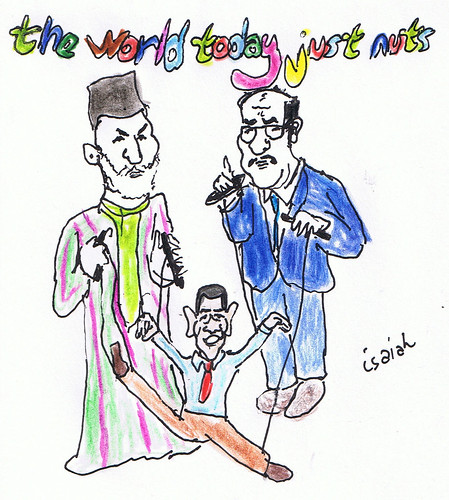
Which is a great excuse to again noteIsaiah's The World Today Just Nuts "These days, puppets pull the strings" from Sunday.


These days puppets pull the strings


I just love that comic. Did Marc Foster direct Daniel Craig's first James Bond feature? Had to look it up. No, he didn't. Martin Campbell directed Casino Royal. And did a great job. I wish I liked Quantum of Solace more, but I don't. Everything's overly lit, like you're watching an old MGM technicolor musical. There's no sense of brooding or danger. The whole thing's badly shot as well. I think Craig and all the actors do a good job, I just think the film's subpar and that it goes to the direction. When you're doing Italy in your opening (I've got it in the DVD player right now, in case you're wondering),you should have something to offer. Instead it's as bad as Bourne II or III. Whichever one Matt Damon's in Italy in.

The camera angles are always too late. For suspense to work, you need to know about stuff ahead of time. But it's always a second before the danger's going to hit (or sometimes a second after) that the cameramoves around to reveal the danger. It's just a pedistrian film. Which is too bad because the actors all work really hard and do a good job.


Going out with C.I.'s "Iraq snapshot:"


Tuesday, April 6, 2010. Chaos and violence continue, Baghdad's slammed with bombings, the refugee crisis is harnessed to offer false praise, and more.

Baghdad has again been slammed by bombings.
BBC News counted "at least 28 people" dead and another seventy-five injured following multiple bombings in the Iraqi capital this morning. The link has video as well as text and the video shows rubble and people attempting to clear it. AFP explains, "Ambulance sirens were heard across the city as emergency service workers rushed to the scenes of the blasts, and a large plume of smoke rose from near a destroyed building in the neighbourhood of Allawi, central Baghdad." Xiong Tong (Xinhua) adds that the death toll increased to 35 and the number injured to 140 and cites a source in the Ministry of the Interior for those numbers and for the assertion that there were seven bombings today. DPA observes, "Tuesday's deadly attacks came only two days after three, apparently coordinated, car bombs killed dozens of people and injured hundreds in the capital, amid tense negotiations on forming a new government after March 7 parliamentary polls." On NPR's hourly news break at 9:00 a.m. EST, Quil Lawrence went with 35 dead and 140 injured as well and noted seven bombings, some of which were strong enough to "bring down buildings." Laith Hammoudi (McClatchy Newspapers) adds, "Security sources said the attacks were implemented by bombs planted near the gates of the buildings in the neighborhoods of Chkook, Shaula, Alawi Al Hilla, Shurta the 4th, Amil and Elam. The attacks came two days after explosions that targeted diplomatic missions in the Iraqi capital, in which more than 40 Iraqis were killed and 224 were wounded." Hammoudi and Hannah Allam also reported that it appears vacant apartments were used as the staging platform for the bombings and they note that, "The story was the same in at least three of the bombed residential complexes: Residents said that unknown renters had leased space in the two-story buildings and never moved in." Echoing that Ned Parker and Raheem Salman (Los Angeles Times) state, "In some of the cases, unknown men had rented rooms in buildings around the city, wired them with explosives and detonated their devices on Tuesday morning." Leila Fadel and Aziz Alwan (Washington Post) remind, "A similar tactic was used on Election Day, when more than 30 people were killed." Timothy Williams and Yasmine Mousa (New York Times) add, "At least five of the bombs were homemade devices placed inside apartment buildings, an unusual tactic. A parker car packed with explosives was also detonated in a Shiite neighborhood in south Baghdad." On today's The World (PRI), the BBC News' Jim Muir.

Marco Werman: Jim, it's kind of rare for these attacks to target apartments, randomly killing these civilians so what do these targets have in common?

Jim Muir: Well they had in common, as you say, that they hit residential buildings. What I would say is this, that since last year we've seen that these coordinated waves of attacks have what I'm calling "themes" to them. Last year, they were hitting government buildings and ministries and so on. In January, we saw a series of attacks, coordinated suicide attacks, nearly simultaneous, on some of the big hotels in Baghdad. This Sunday, it was the turn of foreign embassies in various parts of Baghdad. And now we have the ordinary residential buildings with no particular special people or special facilities there -- just ordinary buildings housing ordinary people. You may ask why? I think they're partly out to show that they can hit all over town at a selected kind of target. They may also be trying once again to provoke the Shi'ite population because most in fact all of these buildings were in areas mainly populated by the Shia Muslims. Now when you had those kind of provocative attacks four years ago it did trigger off a very vicious two years of sectarian warfare which everybody hopes has run its course but the insurgents may be trying to -- or hoping -- to trigger it off once again.

Marco Werman: So if these apartment buildings were targeted in part because they're in Shi'ite neighborhoods -- I mean, does this mean that somebody's trying or some group is trying to stoke sectarian hatreds again?

Jim Muir: That definitely seems to be part of the sub-theme. I mean, I think the overall message is, as I say, they're trying to show that Iraq is deeply unstable, that the political progress and the security progress of the last three years are for nothing and that the insurgents can still strike at random. [. . .]


"Actually, the security situation has improved." Who said that? Here's your hint: Biggest Idiot in US Government. Usually forgets to comb what's left of his hair. Chris Hill. Ambassador to Iraq.
Imran Garda (Al Jazeera) spoke with Hill following Sunday's bombings (link has video) and Hill was trying to Happy Talk his way through the interview. They ought to take that one sentence and just show it over and over at the top of each hour. "There's clear improvement in the security situation," insisted Hill. Hill's US stupid. There's a lot of stupid to go around. But let's move to the White House where the laughable White House press corps asked one of those oh-so-rare questions about Iraq leading Robert Gibbs, White House spokesperson and Spanx spokesperson, to respond, "Well I think many expected that insurgents would use this time to roll back the progress, both militarily and politically, that we've seen in Iraq. The leadership and team here have spoken with our ambassador and with General [Ray] Odierno. He believes that this does not threaten our ability to draw down our roces later in the year. And obviously we are very focused on, and Vice President [Joe] Biden is very focused on, the steps that need to be taken to ensure political advancement in Iraq after these elections." Whole lot of stupid to go around, remember?

None of the reports noting the obvious, maybe in an effort to make-nice with Nouri? But the bombings took place today, yes. Baghdad was slammed with bombings today. And what was the world told yesterday? That's kind of a key detail.

On Monday, Nouri put security forces on high alert. Doubt it?
AFP: "Iraq's security forces were on high alert Monday after three suicide car bombs targeting regional and European embassies rocked Baghdad, killing 30 people. [. . .] Incumbent Prime Minister Nuri al-Maliki, whose coalition finished second in the March 7 general election, held a meeting with Iraq's national security council over Sunday's blasts, a statement from his office said." Wait, it gets better. Sundays bombings? AP reported Monday that one suicide bomber was taken alive, "The official said Iraqi forces were tipped off about a possible attack against diplomatic targets and had begun beefing up security precautions Saturday -- measures he credited with keeping the embassies themselves from serious damage." Beefing up security in Baghdad on Saturday but unable to stop the bombings you've been tipped off regarding. High alert starting Monday and Baghdad's again slammed today by bombings.

Conventional wisdom continues to be that Iraq's elections resulted in 'confusion' and a 'power vacuum' now exists leading to violence. Sounds like too many reporters talking to themselves. It's not as if Nouri doesn't remain sitting prime minister today with the same security forces and militia at his command. He may be ineffective but, even so, that's not a new development. Violence has increased? Following the election? Like the 2005 election? Well the key there, according to poli sci analysts, was not a power vacuum but the stoking of sectarian tensions as campaign strategy. That may or may not be what's happening currently. However, the conventional wisdom doesn't hold up to scrutiny though it does increase in popularity (Allawi is now repeating it).

In other reported violence,
Reuters notes a Baghdad roadside bombing injured one person, a Baquba sticky bombing claimed 1 life and left three preople wounded, a Mosul roadside bombing injured a child, 1 car mechanic was shot dead in Mosul and, dropping back to Monday, a Baghdad roadside bombing claimed 1 life and left five people wounded.

As noted in
yesterday's snapshot, Wikileaks released video Monday of the deaths of Reuters reporters Nami Noor-Eldeen and Saeed Chmagh, killed by the US military. For a critique of Tom Bowman's Morning Edition nonsense, click here. Today, Neal Conan spoke to the Washington Post's David Finkel (who's written about the incident in The Good Soldiers and link has an exerpt of the book) on NPR's Talk of the Nation.

David Finkel: These guys, the Reuters guys, walked into the hottest spot of a very hot morning. There had been running gun battles, there had been a lot of RPG grenade fire and so on. And they were doing what journalists do. They heard about something. They came to it. And they just wanted, from everything I've learned since, they were just there to get that side of the story.
Neal Conan: Can you understand the pain of their families at seeing these videos at last because they'd been pressing for them, Reuters had been pressing for their release, and saying, "How could those helicopter pilots not see that my son was carrying a camera?"

David Finkel: Sure, sure. I can't imagine what it would be like to be them, to be those families and suddenly this video pops up and it would be unimaginable. It's -- I wasn't up in the helicopters, I think that's fair to say. They were a good distance. I'm not quite sure how clear their monitors are. I was told they're only a few inches wide. We're hearing basically intercom chatter [on the video]. It's not like clear radio chatter. Nonetheless, uhm, here comes a group of guys and one of the things they cited on that led to the first burst of fire was an RPG launcher that turned out to be a telephoto lens hanging around a guy's neck.

Finkel did not weigh in on responsibility and noted specifically that he was not villifying anyone or justifying anyone. He repeated this point more than once. We emphasized the above to note the reporters.
Jenny Booth (Times of London) profiles the two reporters and quotes the then-chief photographer for Reuters Bob Strong stating, "Namir was an editor's dream . . . on top of every story. His nose had been broken more than once, he'd been shot in the leg, detained, harassed and threatened, but his quick smile and energy never faded." Of Saeed, Chris Helgren states, "Saeed had a reputation of being fiercely loyal and appeared fearless to me. If you ever needed to get quickly to a dangerous area, passing chicanes of barbed wire and boobytraps, Saeed was your man. But he also had a very quiet, loving side and spoke often of his kids." Mujahid Yousef (New York Times) reports:The family of a Reuters photographer killed in an American military airstrike watched the video of it late Monday and burst into tears as they saw what appeared to be the crews of two American Apache attack helicopters kill their son and 11 other people, gloating at what the crewmen seemed to think was a successful strike on insurgents. "At last the truth has been revealed, and I'm satisfied God revealed the truth," said Noor Eldeen, the father of the photographer, Namir Noor-Eldeen, who was 22 when he was killed in July 2007. "If such an incident took place in America, even if an animal were killed like this, what would they do?"

Kim Sengupta (Indpedent of London) adds:

Reuters had consistently pointed out that its staff were simply carrying out their job. David Schlesinger, the editor-in-chief of Reuters news, said the footage was "graphic evidence of the dangers involved in war journalism and the tragedies that can result".
In Baghdad, the Iraqi Journalists' Union called on the government to carry out an investigation into the killings. The Committee to Protect Journalists, based in New York, supported the demand for an inquiry.

Raffi Khatchadourian (New Yorker) explores possible legal issues stemming from the events captured in the video. And, for any wondering, we're not interested in a debate over WikiLeaks. It had information, it released it. That's what it should have done, that's the reason it exists. Neal Conan, for example, appeared confused as to the parents' reactions regarding the release of the video. The record shows that it was painful for them to watch (no surprise there) but that they were glad to finally know how their son died. As would most people be. Reporters Without Borders issued the following statement today:


Reporters Without Borders is asking the US government for increased transparency after the whistleblower website WikiLeaks released a video on April 5th, 2010, of a US military Apache helicopter strike in Baghdad three years ago which killed two Reuters employees and several other people. Wikileaks said that it had obtained the video "from a number of military whistleblowers" and posted it at
collateralmurder.org.
Reuters filed a FOIA request in for the video back in 2007 but it was never released.
According to the Freedom of Information Act (FOIA), all agencies of the U.S. Government are required to disclose records upon receiving a written request, except those records that are protected from disclosure pursuant to nine exemptions and three exclusions.
"We support Wikileaks decision to post the video because the administration did not live up to its responsibilities in this case," said Reporters Without Borders. "We urge the Pentagon to be more transparent and call on the Obama administration to show its committing to justice by reconsidering the request and officially releasing the video and other elements that would help the investigation".
"By not granting this FOIA request, the Obama administration would once again be ignoring its promises of more transparency and accountability'" said the press freedom organization. "It would be a blow to freedom of the press and to the principle that it is not up to the government to define what is newsworthy."
According to the AFP, A US military official did not dispute the authenticity of the video but said it "doesn't give new information, it just gives footage. "Since 2007, we acknowledged everything that's in the video," the official said. "We acknowledged that the strike took place and that there were two Reuters employees (killed)." "We had insurgents and reporters in an area where US forces were about to be ambushed. At the time we weren't able to discern whether (the Reuters employees) were carrying cameras or weapons," the official said.
In July 2007, photographer Namir Noor-Eldeen, 22, and his driver, Saeed Chmagh, 40, were killed in east Baghdad by gunfire of unclear origin. Witnesses said a rocket was fired from a US helicopter. But other sources told Reuters they could have been killed by a mortar shell fired by Iraqi militia members.
At the time Reporters Without Borders called on both the US army and the Iraqi police to investigate their deaths.
Since the beginning of the Iraq war, at least 221 journalists have been killed, making it the deadliest war for reporters.
On December 31, 2007, George W. Bush signed amendments to the FOIA into law, improving public access to information about federal government activity. However, at that time, 92 videos related to interrogations of Guantanamo Bay prisoners were destroyed and never made public despite a request from the ACLU.
On April 15th, 2010, the CIA will have to release documents detailing meetings between Nancy Pelosi and her aide Michael Sheeny on matters relating to "enhanced interrogation techniques". Reporters Without Borders deeply hope that the US agency will keep its word this time.

The Committee to Protect Journalists' statement includes the following:


"This footage is deeply disturbing and reminds us of what journalists in war zones undergo to bring us the news," said Joel Simon, CPJ's executive director. "The video also confirms our long-held view that a thorough and transparent investigation into this incident is urgently needed."
The video, taken from a U.S. Apache helicopter, shows several men moving about a Baghdad neighborhood. Military forces identify some of the men as armed and open fire, the video shows. Minutes later, a van arrives and appears to assist the wounded. The video shows the helicopter then opening fire on the van. Two children were injured, the footage shows.
Reuters has pressed U.S. military officials to conduct a thorough and objective investigation into the airstrike. In a statement today, military spokesman Maj. Shawn S. Turner said: "This tragic incident was investigated at that time by the brigade involved and the investigation found that the forces involved were not aware of the presence of the two reporters, and that all evidence available supported the conclusion by those forces that they were engaging armed insurgents, and not civilians."
In all, at least 16 journalists were killed by U.S. forces' fire in Iraq, CPJ research shows. While CPJ has not found evidence to conclude that U.S. troops targeted journalists in these cases, its research shows that most of the cases were either not fully investigated or the military failed to publicly disclose its findings.
"The deaths of Namir Noor-Eldeen and Saeed Chmagh three years ago were tragic and emblematic of the extreme dangers that exist in covering war zones," said David Schlesinger, editor-in-chief of Reuters news. "We continue to work for journalist safety and call on all involved parties to recognize the important work that journalists do and the extreme danger that photographers and video journalists face in particular. The video released today via Wikileaks is graphic evidence of the dangers involved in war journalism and the tragedies that can result."

Deborah Amos is the author of the just released
Eclipse of the Sunnis: Power, Exile, and Upheaval in the Middle East. Yesterday, she appeared on The Exchange with Laura Knoy (NHPR) and, except for licking Barack's ass, it was an informative interview.

On Iraqi refugees, she wrongly fawns over Barack Obama. Maybe doing so allows her to avoid her and NPR's little refugee problem? Apparently we have to go historical.


Ethnic cleansing took place -- and the so-called surge provided the cover for it (ugly reality the US government does not want to acknowledge). This led to Iraq's huge refugee crisis. The key moment, and on Amos omits in her book, is November 2007. That's when Nouri al-Maliki began pushing the idea that Iraqis were returning. Initially, CBS News was skeptical. The story began over a weekend and when Nouri and his people saw the news outlets would run with any number they were supplied with, they started inflating their numbers. That's why CBS News was initially skeptical. However, that was that and suddenly all the outlets (including CBS News) were reporting that huge waves of refugees were returning and more would be coming and these were people who wanted to return. At this site, we questioned the numbers (which kept inflating), we questioned the idea that more people were waiting, we questioned the idea that they wanted to return (as opposed to struggling as refugees who weren't allowed to work in their host countries and had exhausted their savings) and more. The news outlets merrily danced along. It was not safe. And I loudly made the point to friends with the UN that if the lie stood, other refugees struggling would think, "Well maybe there is a huge wave returning and we'll be safe as part of the wave." November 22nd, at this site, we loudly called out the
Myth of the Great Return. Barack didn't do a thing at this point -- I know that because I was being hit up every day to donate to him by friends advising the campaign and I would ask, "What's he doing?" He wasn't doing a damn thing.

While the UN decided to sit it out, the Red Cross did step up to the plate and issue a few cautionary notes and then came Cara Buckley and Damien Cave's New York Times reports and the Myth imploded. Who deserves credit? Cara Buckley and Damien Cave and shame on anyone who tries to take that credit away from those two reporters. They earned it. While every other outlet was merely repeating what they were being fed, Buckley and Cave did actual reporting, looked into it and found out what was really going on. And, most important, they reported on it.

What happened then? Other outlets didn't correct their stories, they didn't update their stories even, they just stopped pushing the lies. It would have been great if they could have told the truth. They didn't. But in the wake of Buckley and Cave's reporting, the other outlets stopped issuing Nouri's propaganda. Reporting is supposed to make a difference in people's lives ideally. That's why, in the US, we give it so much respect within the Constitution and the whole free speech tradition. Most days, most years, that doesn't happen. In part because so few of us, as a people, pay attention to actual news and in part because so few outlets do actual news. But it does still happen and Damien Cave and Cara Buckley didn't just type up something and it was fish wrapper two days later. They reported the truth and, by doing so, stopped the lies, stopped the propaganda thereby saving many Iraqi lives. That's true not only due to the fact that it wasn't safe (and it wasn't) but also because those returning were being robbed, kidnapped and killed.

The only two who deserve credit -- and this is in the entire media landscape and, yes, that includes NPR and Deborah Amos -- are Damien Cave and Cara Buckley. Their reporting saved lives. They made a difference.

Amos is correct that George W. Bush's administration (though she seems to imply Bush himself who, honestly, wasn't all that into the issue of refugees and was way out of the loop) wanted the Myth to stand. She seems to forget or overlook that Nouri's the one who started it and, of course, it benefitted him as well. (It was step one in the p.r. for "Nouri has restored security!") She also ignored -- in her conversation -- that people didn't know where Barack stood on refugees when he was elected. Sheri Fink wondered "
Will New Admin. Deliver on U.S. Pledge to Iraqi Refugees?" November 6, 2008. Fink wouldn't have to wonder if Barack had a record on the issue. Writing at The Huffington Post, November 4, 2008, Deborah Amos herself did not note any great work -- or any work -- by Barack on the issue and ended her column stating: "It is up to the new Obama administration to address the long term consequences of the exodus" ("Iraqi Refugees Still Too Scared to Return Home"). In her new book, page 193 contains 2 sentences on the issue:

As a candidate for president, Barack Obama aimed to measure an end to displacement and exile as a benchmark of Iraq's long-term stability. President Obama linked the refugee crisis again when he oulined his plan for an accelarated U.S. withdrawal from Iraq.

What? As president, Barack did not present "an accelarated US withdrawal from Iraq." He promised one brigade a month removed upon being sworn in. That was his promise. He broke that promise and went with a slower plan. She may be confusing a drawdown with a withdrawal. But Barack's withdrawal (or 'withdrawal') plan is George W. Bush's plan.

So it's a bit hard to reconcile history, the public record, Amos' own remarks in real time and her own book with her Monday comments and praisings of Barack allegedly putting this issue front and center as a candidate and making the press cover it and blah, blah, blah.
Elise Labott never needed arm twisting to cover this and was covering it long before Barack teamed up with Joe Biden. Joe Biden, by the way, was a leader on this issue. As late as June of 2008, where was Barack? June 20, 2008, World Refugee Day, Biden joined with Senators Ted Kennedy, Chuck Hagel and Gordon Smith were sponsoring legislation (introduced that day by Senator Majority Leader Harry Reid) to create a White House position for a go-to on Iraqi-refugees. Nothing stopped Barack from being a co-sponsor except his lack of interest in the subject. Once Biden is Barack's running mate, at Change.gov.org (the campaign website), you begin seeing papers on the Iraqi refugee crisis. Barack had no foreign policy experience which is one reason Biden was chosen as Barack's running mate. Once on board, the campaign beefed up the team's positions on international issues. For example, "The Obama-Biden Plan" was largely written by Biden's staff including the section on refugees ("Preventing Humanitarian Crisis") and all you have to do is read over it to grasp that especially the part about the US intervening militarily if a genocide were to take place.

There are actual heroes and two of their names are Cara Buckley and Damien Cave. Barack is not a hero on this issue nor is he a leader on it. That was true of Candidate Obama and it's true of President Obama. Deborah Amos has written a great book and we'll note it in the future but I don't play when it comes to the refugee situation and I don't pretend that things happened when they damn well didn't. I'll further add that all these people trashing Bush today? Where were you when we actually needed you? Again, Amos says the US administration didn't want the refugee story covered. Under Bush. Is that why so many LIED. Buckley and Cave didn't lie. And I won't be silent or go along with vanishing their work that they should be very proud of and that all of us who depend upon the press should be grateful they provided in real time.


"Yes, folks, it's true,"
writes NOW on PBS executive producer John Siceloff, "NOW on PBS has come to the end of its broadcast run. The last episode will air on April 30, 2010. PBS announced last fall it was canceling NOW and providing funding for a new public affairs show called Need to Know." Click here for the rest of his essay. The program begins airing each week on Fridays on most PBS stations (check local listings) and this week they look at the economy:

The national economic disaster hit the city of Braddock Pennsylvania like a wrecking ball. But Braddock Mayor John Fetterman -- dubbed "America's Coolest Mayor" by The New York Times -- is taking very unconventional approaches to reinventing the town and re-inspiring its residents. Home to the nation's first A&P supermarket and Andrew Carnegie's first steel mill, Braddock is being revitalized with new youth and art programs, renovations of abandoned real estate, and bold plans to attract artists and green industries. On Friday, April 9 at 8:30 pm (check local listings), NOW sits down with Mayor Fetterman to learn how the 6'8" 370-pound political novice is trying to turn his town around, and if other devastated communities can and should follow his large footsteps.

Lastly, the
Democratic Policy Committee notes:
The Democratic Policy Committee has updated its Special Report on the benefits of health reform in every state, available via the link below, both on and off the Hill. The number of small businesses in each state estimated to qualify for the small business tax credit has been updated to reflect final bill language of firms with fewer than 25 employees and average annual wages of less than $50,000. The previous report used the lower average annual wage threshold of $40,000, which was included in the bill as introduced. The effect has been to increase the number of small businesses estimated to qualify for the tax credit in every state and the District of Columbia .
The Benefits of Health Reform (State-by-State Reports)


iraqbbc newsxinhuaxiong tongdpanprquil lawrence
mcclatchy newspaperslaith hammoudithe new york timestimothy williamsyasmine mousa
hannah allam
the los angeles timesned parkerraheem salman
the washington postleila fadelaziz alwan
mujahid yousefthe times of londonjenny booth
nhprthe exchangelaura knoydeborah amos