After a strong episode last week, they were back with a useless one this time.
Oliver can't even attend his mother's funeral.
Don't give me that crap about his 'need' to Arrow. His sister, his kid sister, needed him.
She was kidnapped how many episodes ago?
And he was furious with himself and he was going to be there for her from now on and . . .
This show is becoming sewer crap.
At work, they're wondering if Roy and all the men hang around because the man who created the show (he's gay) hates women?
I don't know why he hates women, but, yeah, he clearly hates women. And you can toss in the hard on Greg's got for Daddy Roger, Bro Jedicah, Stephen and John on Tomorrow People as the women there get sidelined as well.
I feel less and less like I'm watching a TV show and more and more like I'm trapped in Greg's sexual fantasies.
This episode is the big battle and Black Canary is MIA.
And they killed off Mommy.
And Laurel's being shoved aside.
But we get more of Sebastian.
Does Sebastian look like a mayor?
To me, he looks like a trick working a bar in some hotel.
That's probably why he got hired. Hell, that might have been his audition piece.
Felicity's doing nothing in a van. Laurel is playing damsel in distress ("we can't fight all of them," she tells Oliver about Slade's men -- and it's men plus Summer Glau)
So nothing happens the whole epiode and then in the nine or so minutes, we get all hell breaking loose.
I'm so sick of this crap.
My cousin Marcia wrote the following about "Revolution:"
Revolution needs Shonda Rhimes. I've often complained about the lack of African-Americans and the lack of women and Shonda would surely fix those issues. But, most importantly, Shonda would add some action to this oh-so-slow show. She does more, for example, with one episode of Scandal than Revolution managed to do in ten.
Shonda should be writing "Arrow" as well. Even setting aside the lousy flashbacks (and that lousy wig Oliver wears in the flashbacks), the show has a real problem lately coming up with an episode. They can give you nine good minutes at the end but they're so slow and so boring the rest of the episode.
Going out with C.I.'s "Iraq snapshot:"
Senator Bernie Sanders: Within the veterans' community -- and in fact, the nation both in the public sector and the private sector -- we face a very serious problem as a nation of overmedication. The result of that overmedication is that significant numbers of people treated in the Department of Defense facilities, in VA facilities and in the private sector become dependent upon those medications intended to help them and ease their pain. Pain relief is a huge problem in the country and how we treat that pain in the most effective way is really what we're discussing today. Some people who are treated with a whole lot of medication become addicted -- and I think we all know what happens when people become addicted -- and some in fact will end up taking -- losing their lives through overdoses. And in my state and throughout this country this is a huge problem as well. So this is a major issue which has been discussed in this committee during the last year and we're really glad we have such a distinguished panel to discuss this issue.
We're starting in the US and dropping back to yesterday for a Senate Veterans Affairs Committee. Iraq voted in parliamentary elections yesterday, we focused on that, there wasn't room for the Wednesday hearing. Senator Bernie Sanders is the Chair of the Senate Veterans Affairs Committee and Senator Richard Burr is the Ranking Member.
The big news of the hearing?
The big news was about the allegations of deaths.
What allegations of death?
Dropping back to the April 9th snapshot to note this from that day's House Veterans Affairs Committee hearing:
US House Rep Jeff Miller: I had hoped that during this hearing, we would be discussing the concrete changes VA had made -- changes that would show beyond a doubt that VA had placed the care our veterans receive first and that VA's commitment to holding any employee who did not completely embody a commitment to excellence through actions appropriate to the employee's failure accountable. Instead, today we are faced with even with more questions and ever mounting evidence that despite the myriad of patient safety incidents that have occurred at VA medical facilities in recent memory, the status quo is still firmly entrenched at VA. On Monday -- shortly before this public hearing -- VA provided evidence that a total of twenty-three veterans have died due to delays in care at VA medical facilities. Even with this latest disclosure as to where the deaths occurred, our Committee still don't know when they may have happened beyond VA's stated "most likely between 2010 and 2012." These particular deaths resulted primarily from delays in gastrointestinal care. Information on other preventable deaths due to consult delays remains unavailable. Outside of the VA's consult review, this committee has reviewed at least eighteen preventable deaths that occurred because of mismanagement, improper infection control practices and a whole host -- a whole host -- of other maladies plaguing the VA health care system nationwide. Yet, the department's stonewall has only grown higher and non-responsive. There is no excuse for these incidents to have ever occurred. Congress has met every resource request that VA has made and I guarantee that if the department would have approached this committee at any time to tell us that help was needed to ensure that veterans received the care they required, every possible action would have been taken to ensure that VA could adequately care for our veterans. This is the third full committee hearing that I have held on patient safety and I am going to save our VA witnesses a little bit of time this morning by telling them what I don't want to hear. I don't want to hear the rote repetition of -- and I quote -- "the department is committed to providing the highest quality care, which our veterans have earned and that they deserve. When incidents occur, we identify, mitigate, and prevent additional risks. Prompt reviews prevent similar events in the future and hold those persons accountable." Another thing I don’t want to hear is -- and, again, I quote from numerous VA statements, including a recent press statement -- "while any adverse incident for a veteran within our care is one too many," preventable deaths represent a small fraction of the veterans who seek care from VA every year. What our veterans have truly "earned and deserve" is not more platitudes and, yes, one adverse incident is indeed one too many. Look, we all recognize that no medical system is infallible no matter how high the quality standards might be. But I think we all also recognize that the VA health care system is unique because it has a unique, special obligation not only to its patients -- the men and women who honorably serve our nation in uniform -- but also to the hard-working taxpayers of the United States of America.
Miller is the Chair of the House Veterans Affairs Committee. Like Miller, Sanders takes this issue seriously and noted it in his opening remarks. He noted, "I just spoke to the VA's Inspector General yesterday. There is a thorough investigation taking place in Phoenix and Richard Griffin who is the VA's Acting Inspector General told me that he has the resources that he needs to thoroughly investigate that situation."
Keep that in mind.
The big disgrace that is the VA's Dr. Robert Petzel told the Committee, "I need to say that to date, we found no evidence of a secret list. And we have found no patients who have died because they were on a wait list."
Did you grasp what just happened because the press didn't?
I've heard Jen Psaki, Marie Harf, Victoria Nuland, Jay Carney, Robert Gibbs, Dana Perino and many more explain, when asked, that they couldn't what?
Remember?
Pick any controversial and embarrassing topic and what do they say, "I'm sorry. I can't comment on an ongoing investigation."
But Petzel didn't say that -- despite it being an ongoing investigation.
So, in fact, we now know that they can comment on an ongoing investigation, they just don't want to.
After denying any guilt, Petzel then declared, "We think it's very important that the Inspector General be allowed to finish their investigation before we rush to judgment as to what has actually happened." But he rushed to judgment when he denied it.
Today, the Veterans Affairs Dept released the following statement:
WASHINGTON – Secretary of Veterans Affairs Eric K. Shinseki made the following statement on the allegations regarding the Phoenix VA Health Care System:
“We take these allegations very seriously. Based on the request of the independent VA Office of Inspector General, in view of the gravity of the allegations and in the interest of the Inspector General’s ability to conduct a thorough and timely review of the Phoenix VA Health Care System (PVAHCS), I have directed that PVAHCS Director Sharon Helman, PVAHCS Associate Director Lance Robinson, and a third PVAHCS employee be placed on administrative leave until further notice.
“Providing Veterans the quality care and benefits they have earned through their service is our only mission at the Department of Veterans Affairs. We care deeply for every Veteran we are privileged to serve.
“We believe it is important to allow an independent, objective review to proceed. These allegations, if true, are absolutely unacceptable and if the Inspector General’s investigation substantiates these claims, swift and appropriate action will be taken.
“Veterans deserve to have full faith in their VA health care. I appreciate the continued hard work and dedication of our employees and of the community stakeholders we work with every day in our service to Veterans.”
# # #
The issues were covered on Anderson Cooper 360 tonight on CNN (link is video and text).
We'll move back to the hearing to note the issue of alternative and complimentary medicine.
Chair Bernie Sanders: (A) Dr. Petzel how serious is the problem that you are addressing and (B) and Dr. Martin might want to join in, tell me the role you think complimentary alternative medicine can play in addressing those problems?
Dr. Robert Petzel: [. . . Microphone not on . . .] First of all in terms of the magnitude of the problem, several have mentioned it, we estimate that 50% of the veterans that are coming to us seeking care have some sort of, uh, pain. Uh, much of it is muscular, skeletal, back pains, etc. associated with the, uh, work that a soldier, sailor, air man, marine, uh, maybe doing. Uh, we are prescribing opiates for somewhere around 650,000 veterans at this particular present time which includes a large number of people and we recognize the fact that this is an issue that has to be addressed very directly. Uh, I would like to just take a minute before I turn to the, uh, other panel members to describe the opioid safety program that we're involved in to try and get a grip on and reduce the use of opiates which, by the way, has reduced the number of patients receiving opioids in the last eighteen months by 50,000. Still a lot of people getting it --
Chair Bernie Sanders: 50,000 fewer veterans are now receiving opiates?
Dr. Robert Petzel: That's correct. The five things that are, uh, the central part of the pain management program are (1) every medical center has to have a pain management clinic, (2) every medical center has a pain consultation service -- VA requires the use of, uh, integrative, uh, cam approaches. We, uh -- And we make get into the details of this -- we require the use of a step-care model which was developed in the VA and which I think has been adopted by the Dept of Defense now which begins with -- in the primary care clinic -- self-management and management in primary care of pain, if needed, it moves to a secondary pain clinic. And then finally there are tertiary pain services available. The centerpiece of this, though, is the opioid dashboard monthly report to the facilities, to the providers of the facilities and to the pain management point of contact about people who are prescribing outside of the standard and patients that are taking medications outside the standard. That then is followed by education and discussion and consultations with the providers to bring their use of opioids into uh-uh -- into the standard.
Chair Bernie Sanders: If I can interrupt you, we'll take a little bit more time for everybody because we only have four of us here. But I wonder, if it's okay with you, Dr. Petzel, I wanted to shift over to Dr. Gaudet, Dr. Marshall, what are you doing with complimentary and alternative medicine and is it, in fact, working?
Dr. Tracy Gaudet: Uh, thank you, Chairman Sanders. I think you're, uh, aware that the, uhm, vision for health care -- and Ranking Member Burr referenced personalized proactive patient driven -- central to that- are strategies that are inclusive of complimentary approaches that empower the veteran to take into their own hands -- whether it's pain issues, of course, this extends far beyond pain to the many, many conditions facing veterans and our public that are complex conditions where a simple fix does not exist. Uhm, so I think that these areas -- particularly pain -- are phenomenal places where the VA is committed to bringing more holistic approaches to veterans. The veterans are finding them very, very empowering, very much an asset to their compliment of what they can do to address their issues with pain as well as others.
Chair Bernie Sanders: In --
Dr. Tracy Gaudet: Yes, sir?
Chair Bernie Sanders: In English --
Dr. Tracy Gaudet: Yes, sorry.
Chair Bernie Sanders: What am I -- What are you offering a patient? So somebody walks in, they have chronic pain, they're concerned about over medication. You are concerned. What are the therapies that you are offering? And are they in fact working? These are fairly radical ideas in a certain sense, right? Or not?
Dr. Tracy Gaudet: I don't know how radical they are but I think that the conditions -- that the therapies that are most promising and are most often utilized right now in the VA are very parallel to the DoD and the public so they tend to be mind-body approaches such as meditation, acupuncture movement therapy such as yoga, Tai Chi, spinal manipulation. These are -- These are the general approaches that seem to have the greatest promise that are relatively, you know, non-invasive and low risk.
Chair Bernie Sanders: Now I have been impressed. I have been to VA facilities all over the country and I've been to a couple of DoD facilities and I am amazed. You know, twenty or thirty years ago, I think it's fair to say, that if we were talking about this list of therapies, people would have thought that they may have been a few folks in California or certain places that might be utilizing them -- not the Dept of Defense or the VA. So, in terms of programs like the acupuncture, is it working? What can you tell us about your success rates or non-success rates? Does the success work?
Dr. Tracy Gudet: I think the most evidence that actually exists for acupuncture as it relates to pain, our research Office of Evidence Synthesis just finished a comprehensive look at all the evidence related to acupuncture and it's a very useful document because it basically says where is their evidence for the use of acupuncture, do we know and is there evidence of benefits, do we know it's not a benefit or is there a category where we just don't know from the research? The areas where there is the strongest evidence for acupuncture are pain -- chronic pain, headaches, migraines have the best evidence. So it's a rational place to start.
Chair Bernie Sanders: Alright Dr. Marshall, if I walk into your beautiful facility in Minneapolis -- I was just there a few days ago -- and I am in pain, what are my options other than drugs?
Dr. Marshall: I would say at Minneapolis, we view pain management as a full spectrum opportunity to engage with a patient and move them towards healthier and a more functional life so we have deployed various complimentary, alternative modalities at different levels of our facility. For instance, nurses -- we trained 900 nurses in January of this year -- a four hour training in complimentary and alternative medicine and integrative nursing. Modalities that we trained nurses in specifically that included acupuncture, reflexive breathing, meditation and essential oils and aroma therapy so --
Chair Bernie Sanders: Do your -- Do your patients gravitate -- when you tell them that these therapies are available, do they say, 'Nah, I really don't want that'? Or do they say, 'Hey, I would like to experience that.'? What do they say?
Dr. Peter Marshall: There's a lot of variability. Uh, some patients, uh, express a strong desire for opioid pain medications. Many patients, though, are very open, once they learn that these are a standard part of our medical treatment at Minneapolis VA, I think many patients are gravitating towards these kind of services.
Chair Bernie Sanders: And can you tell us some success stories? Are there people have gone and they are in pain and are heavily medicated, got rid of the medication and then because of complimentary medicine -- Dr. Gaudet, do you have stories that -- or Dr. Marshall?
Dr. Peter Marshall: Yes. I-I would like to talk briefly about a program that we have just started. This is part of the VA's efforts to have, uhm, our, uh, Council for Accreditation of Rehabilitation Facilities, CARF, rehab VISN at each facility. So we started in January of this year. We recruited the director of the Mayo Clinic Pain Rehab Center who is now leading our efforts. So that program, which is just starting at Minneapolis VA, had seven veterans. Four of them were on opiaids. Three of them were tapered off and one was tapered down. And the cornerstone of that program that's a three week intensive program, the cornerstone of that program is activating patients' innate healing abilities through the use of primarily complimentary and alternative modalities including cognitive behavioral therapies: meditation, relaxation breathing, Tai Chi, yoga and other active --
Committee Chair Bernie Sanders: So you have some specific indications that these therapies are working
Dr. Peter Marshall: Yes.
Committee Chair Bernie Sanders: Okay.
In other news . . .
The United Nations issued a statement today which included the following:
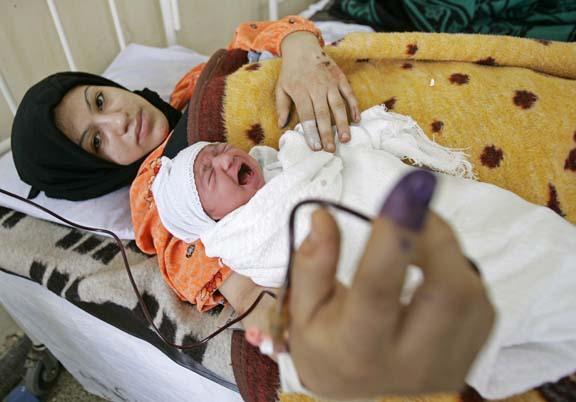
United Nations officials today congratulated the people and Government of Iraq for turning out in significant numbers in Wednesday’s elections, and commended the electoral authorities and security personnel for their efforts.
In a statement issued by his spokesperson in New York, UN Secretary-General Ban Ki-moon applauded the determination of the Iraqi people and electoral officials “to strengthen the country’s democratic processes.”
Mr. Ban encouraged patience while the ballots are being counted and complaints adjudicated.
“I congratulate all Iraqis who have shown incredible resilience by turning out in significant numbers on Election Day to vote. In some areas, this has meant long hours of waiting while enduring extremely difficult security challenges,” said Nickolay Mladenov, the Secretary-General’s Special Representative and head of the UN Assistance Mission for Iraq (UNAMI).
“The commitment to democracy of the majority of people in this country; their readiness to brave harsh security challenges in order to build an inclusive state need to be applauded by all.”
Mr. Mladenov also commended the efforts made by the Independent High Electoral Commission (IHEC), as well as the dedication of security personnel across the country, for the elections, which he said were held in a professional manner and which are crucial to the country’s democratic transition.
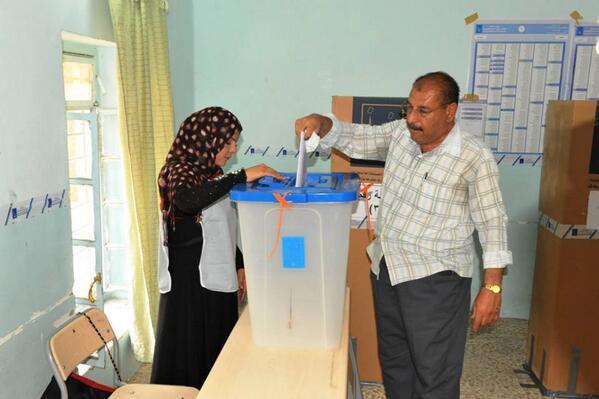
Yesterday, Iraqi voters cast their ballots for the Council of Representatives, or legislature, in what was the country’s third national election under the 2005 Constitution. On the same day, voters in the Kurdistan Region went to the polls to choose their Governorate Council representatives.
The envoy noted that although in the lead up to Election Day, violence across Iraq had spiked, with polling stations, candidates and voters alike being targeted, large parts of the country reported few if any incidents on Wednesday. On the security side, the majority of incidents that have been reported were in Ninewa, Anbar, Salahadine, some areas around Baghdad, and Kirkuk in particular.
“The election process however is not over yet,” said Mr. Mladenov. “I want to use this opportunity to urge all to be patient and to give IHEC the necessary space to carry out through established procedures.
“I call on all political entities to refrain from such actions and statements that may influence IHEC. I call on them to direct any complaints to the appropriate IHEC offices, and to respect the final decisions.”
And the United Kingdom's Foreign Secretary William Hague issued the following statement:
I congratulate the people of Iraq on their national elections today.
Despite the serious challenges that Iraq faces, it is inspiring to see that millions of Iraqis have seized the opportunity to choose their new government and I pay tribute to their courage and commitment to the future of their country. I condemn those who have sought to disrupt the elections through terrorist attacks.
Now voting is over, I hope that all parties will demonstrate respect and patience whilst the ballots are counted and checked. It will be vital for Iraq’s future that today’s election is part of a fully inclusive political process that represents and considers the needs of all Iraqis.
We'll note US President Barack Obama's statement (in full) tomorrow. We already noted US Secretary of State John Kerry's yesterday.
Yesterday, Iraqis voted in their first parliamentary elections in four years. Xinhua reports, "The polls kicked off at 7:00 a.m. local time (0400 GMT) and closed at 6:00 p.m. (1500 GMT), during these hours insurgents attacked many polling centers across the country, leaving a total of 22 people dead and 62 others wounded, mostly security members and voters who defiantly headed to cast their votes with the hope of bringing better life for their families." All Iraq News notes, "The Independent High Electoral Commission fined candidates of ten political entities participating in the parliamentary elections of 2014 for violating the regulations of the electoral campaigns." While voters and violence could be seen, in the capital, one thing could not be seen. Foreign Policy's David Kenner (The Reporter) noted that was cars, "In a sign of Iraq’s struggles to tackle rising violence and terrorist attacks, authorities banned all private vehicles from the streets of the capital and other Iraqi cities in an effort to prevent the type of catastrophic car bombings that have killed tens of thousands of Iraqis in recent years." A lot of the talk of 'success' fails to recognize that the capital was -- yet again -- shut down, businesses had to close, traffic had to be halted and additional checkpoints set up. And that was in the capital. Xinhua offers a photo essay by Cui Xinyu.
RT's Nadezhda Kevorkova reports:
Entering the country has been forbidden since Monday. All flights have been canceled and bus services have been suspended. Nobody can get in or out of Baghdad. This is the atmosphere in which the first Iraqi parliamentary elections are being since the withdrawal of US forces. Somehow people have forgotten that when the Americans were here, it was problematic to cross a street, let alone enter the country.
The mass media all over the world present Iraq as bankrupt and overwhelmed with terror. The reason for the terror is not the American invasion 11 years ago, but some inborn inability of different religious groups to exist in a civilized manner. Iraqi journalists are concerned about the fact that four US channels are reportedly planning to open offices in Baghdad after the elections. “They invited me to work for them. They are looking for people. The US mass media don’t turn up for no reason. They always know if something is about to unfold somewhere,” one journalist says.
Nobody approves of the measures taken by the government. While US forces were present in Iraq, people tried to avoid talking about the victims. When they left, there’s hardly anyone who wouldn’t criticize Iraq.
Nouri was crowning himself the winner yesterday -- despite Iraq's Independent High Electoral Commission (IHEC) shooting those claims down and stating it would take twenty to thirty days before the results were released -- and he continued crowning himself the winner today. AFP reports, "Iraq's premier said on Thursday he had enough support to keep his post, but with election results not due for weeks and parties bitterly divided, forming a government will probably take months."
As he lies and spins, Nouri gets even more ridiculous. AFP quotes him insisting he won't "cling" to the post of prime minister. He's already attempting to cling to it. Alsumaria quotes him insisting today that Iraq needs a political majority government. This means he doesn't want to share power. But then, the world already knew that when he used a power-sharing agreement to get a second term (despite losing the 2010 elections) and then he refused to honor the power-sharing agreement. The US-brokered Erbil Agreement was the legal contract the White House used to go around the 2010 vote, democracy and the Iraqi Constitution in order to give Nouri a second term. The editorial board of the Washington Post notes, "Eager to withdraw all U.S. forces during his first term, Mr. Obama backed Mr. Maliki following the 2010 election even after it became clear his coalition had been brokered by Iran."
Alsumaria reports State of Law (his coalition) is issuing public statements that he is a leader and he must have a third term. Rudaw speaks with Speaker of Parliament Osama al-Nujaifi who also heads the Mutahidun List and he states "that his group will not form an alliance with" Nouri. Dignity candidate Abdel Khalaq Mohammed tells Matt Bradley and Ali A. Nabhan (Wall St. Journal), "If Maliki manages to stay in his post for a third term, I think we will have endless sectarian war that might demolish Iraq."
The Economist notes:
Despite his party coming second last time, in 2010, Mr Maliki has achieved an extraordinary grip on power since 2006, when he was installed as a compromise candidate after the Americans, who then pulled the strings, lost faith in his predecessor, Ibrahim al-Jaafari. In his two terms as prime minister, he has quietly taken control of the country’s security and intelligence forces, with personal loyalty to him as the chief route to advancement. For the past four years, Iraq has had no interior minister, so Mr Maliki has himself overseen the police, and an acting defence minister has not been formally confirmed in his post. While not considered personally corrupt, as many of his colleagues brazenly are, Mr Maliki has also sought to gain control over the state’s financial institutions. And he has used the courts to hammer his opponents.
But he has few dependable allies left, even among his own Shia bloc, so his retention of power is not certain. One of his main rivals, Iyad Allawi, a secular Shia who is one of few prominent Iraqis to reach across the sectarian gulf to seek allies of another denomination, is so bitter about the way he was prevented from becoming prime minister after his group won the most seats last time round, that he has vowed to abandon politics if Mr Maliki retains his post. “Either Iraq can remake itself, rebuild and move ahead,” says Mr Allawi. “Or it will be destroyed; I believe we are approaching a final stage.”
David Romano (Rudaw) offers this take:
What too many people seem to forget is that such a balance, based on concessions and a high a level of consensus, was already arrived at nine years ago: it is called the Iraqi Constitution. The constitutional referendum saw 78.59% of Iraqis accept the new social and political contract, and the mostly Sunni Arab areas who voted ‘no’ at the time have now come to embrace the Constitution. One simply does not get more consensus than that, especially in countries like Iraq. What’s more, the Constitution balanced the powers of the central government, the regions, the governorates and the different branches of the government in Baghdad so that no one actor could monopolize power.
So what happened? Nuri al-Maliki and his ministers happened. As soon as they occupied the seats of power in Baghdad, they busied themselves by flouting the constitution and trying to concentrate as much power as they could into their own hands. Their mostly Shiite constituents quickly forgot what it feels like to be excluded and discriminated against, and cheered when promises to Kurds, Sunni Arabs, liberals, secularists and various regional politicians were broken time and time again.
Yesterday was not only a day of voting, it was also the end of the month and various bodies are releasing their end of the month counts on the victims of violence. UNAMI issued the following report:
Baghdad, 1 May 2014 – According to casualty figures released
today by UNAMI, a total of 750 Iraqis were killed and another 1,541 were
injured in acts of terrorism and violence in April*.
The number of civilians killed was 610 (including 140 civilian
police), while the number of civilians injured was 1,311 (including 266
civilian police). A further 140 members of the Iraqi Security Forces
were killed, and 230 were injured (not including casualties from Anbar
operation).
“As violence continues, I once again stress the need for unity and a holistic approach to dealing with the terrorist threat in Iraq. Only through a combination of effective security operations, political engagement and socially inclusive policies can social peace be promoted”, the Special Representative of the United Nations Secretary-General for Iraq (SRSG), Mr. Mladenov said.
Anbar excluded, Baghdad was the worst affected Governorate with 833 civilian casualties (252 killed, 581 injured), followed by Ninewa (119 killed, 219 injured), Diyala (71 killed, 163 injured), Salahadin (63 killed, 133 injured), and Kirkuk (42 killed, 73 injured).
Operations in Anbar
According to information obtained by UNAMI from the Health Directorate in Anbar, the total civilian casualties in Anbar up to 29 April inclusive were 135 killed and 525 injured, with 57 killed and 265 injured in Ramadi and 78 killed and 260 injured in Fallujah.
*CAVEATS: Data do not take into account casualties of the current IA operation in Anbar, for which we report at the bottom the figures received by our sources.
“As violence continues, I once again stress the need for unity and a holistic approach to dealing with the terrorist threat in Iraq. Only through a combination of effective security operations, political engagement and socially inclusive policies can social peace be promoted”, the Special Representative of the United Nations Secretary-General for Iraq (SRSG), Mr. Mladenov said.
Anbar excluded, Baghdad was the worst affected Governorate with 833 civilian casualties (252 killed, 581 injured), followed by Ninewa (119 killed, 219 injured), Diyala (71 killed, 163 injured), Salahadin (63 killed, 133 injured), and Kirkuk (42 killed, 73 injured).
Operations in Anbar
According to information obtained by UNAMI from the Health Directorate in Anbar, the total civilian casualties in Anbar up to 29 April inclusive were 135 killed and 525 injured, with 57 killed and 265 injured in Ramadi and 78 killed and 260 injured in Fallujah.
*CAVEATS: Data do not take into account casualties of the current IA operation in Anbar, for which we report at the bottom the figures received by our sources.
AFP's Prashant Rao Tweets 795 violent deaths in April:
 Prashant Rao
Iraq death toll in April is among its worst in years - @AFP: http://u.afp.com/Q3x pic.twitter.com/5h7JrQYKm4

Iraq Body Count counts 1013 dead from violence in April. Antiwar.com keeps their own count and Jason Ditz reports, "Antiwar.com’s figures show 2,034 people killed nationwide in April, an increase from the 1,886 killed in March. 2,337 others were wounded. The Antiwar.com toll was in line with Iraq’s own figures on civilians and security forces, which put the toll at 1,009 (Antiwar.com figures were 1,041 for this subset)."
Aswat al-Iraq quotes Nouri declaring of the attacks on Anbar Province "it shall be solved soon." Yet today, Alsumaria reports, he declared the battle of Anbar will drag on for some time. Nouri's always talked out of both sides of his mouth. Nouri's War Crimes in Anbar continued today as he continued to use collective punishment in attacking Falluja. Alsumaria reports the bombing of the residential neighborhoods of Falluja left ten adult civilians and 1 child injured. NINA notes a second round of bombings which left 5 civilians dead and ten more injured.
In addition, Alsumaria reports a Babylon Province bombing left two children injured, a Babylon battle left one Iraqi military officer injured, and a Kirkuk roadside bombing left 1 Iraqi military officer dead. National Iraqi News Agency reports a southwest Baghdad bombing left four people injured, five people were kidnapped in Haditha,
iraq
cnn
the washington post
afp
prashant rao
national iraqi news agency
alsumaria
all iraq news


 UN News Centre
 KRG
KRG
 Nadia Rassoul


 Rebaz Qaradaghi